
Fabric Apps: from reporting to action in Microsoft Fabric
At FabCon Europe 2026, one of the most talked-about topics was Fabric Apps-applications built and hosted directly in Microsoft Fabric. Following their presentation, a question quickly emerged across the industry: is this the end of Power BI as we know it?
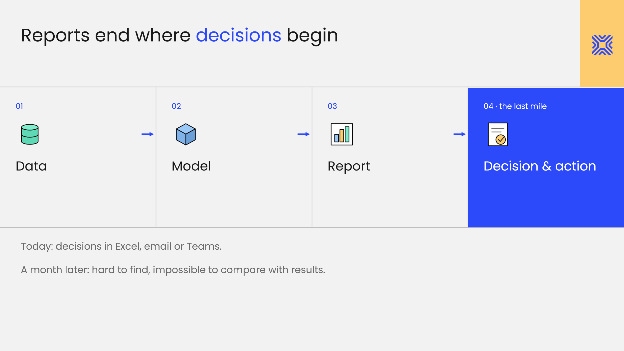
The answer is simpler than the headlines suggest. Microsoft is not replacing reports; it is closing the loop on what happens next. A report shows what happened. The decision someone makes based on it usually ends up in Excel, an email, or a Teams thread-outside the tool that holds the data. Microsoft calls this stretch the “last mile”: from insight to decision, action, and a permanent record of that decision. Fabric Apps aim to bring this last mile to where the data already lives.
What are Fabric Apps?
Microsoft defines a Fabric App in a single sentence: a web application hosted in Fabric, built on data in Fabric, and powered by Rayfin. Hosted in Fabric means no servers of your own and no separate hosting. Built on data in Fabric means the single source of truth approach and the use of OneLake still apply.
The reasons this solution is needed are familiar to every data team. Until now, building even a simple application to record decisions required a series of complex steps and involvement from IT. For a process involving just a handful of people, no one would take that on-and the insights stayed in the report.
Rayfin: an application backend as a ready-to-use service
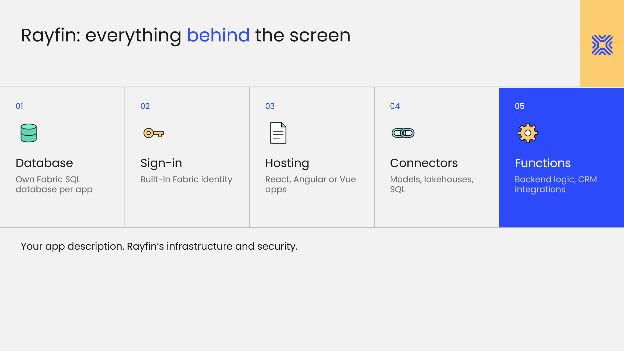
Behind Fabric Apps is Rayfin, an open-source Microsoft tool that acts as a backend as a service. It handles everything the user does not see on screen, across five components:
- Database-each application gets its own SQL database in Fabric, for example to store decisions, comments, and approvals.
- Authentication-built-in Fabric identity and security, with no separate account system.
- Hosting-applications can be built using popular frameworks such as React, Angular, or Vue.
- Connectors-access to semantic models, warehouses, lakehouses, and SQL databases in Fabric.
- Functions-custom server-side logic, including integrations with external systems such as CRM.
Two ways to build Fabric Apps
Microsoft demonstrated two ways to create Fabric Apps, both of which lead to the same destination-an item in a Fabric workspace:
- Agent + Rayfin
The creator describes the application to a coding agent, for example in GitHub Copilot with the Rayfin plugin. The agent creates the project and publishes it to Fabric.
- Modern report in Power BI Desktop (coming soon)
An announced experience in which report authors start with a semantic model, describe the application in natural language, and have Copilot generate it. The appearance can then be changed without code, while a developer can take over the project in VS Code.
Licensing, availability, and governance
Fabric Apps with a Power BI Pro license
One of the most important announcements in Barcelona was support for Fabric Apps under Power BI Pro licenses: Microsoft announced that application creation in Power BI would enter preview for Pro and Premium Per User licenses-at no additional cost and with a database of up to 1 GB per application.
What should you check before deployment?
As of November 3, 2026:
- Building without Fabric capacity - the preview for Pro and PPU licenses has not launched; the documentation still requires Fabric capacity.
- Fabric apps are not available in all regions - before you start, check availability in your capacity’s region: Regional Fabric and Power BI workload availability
The semantic model matters more than ever
Do AI/ML-generated applications make semantic models unnecessary? Microsoft’s answer is clear: quite the opposite. Without a semantic layer, an agent asked to show “growing sales” might simply fit the numbers to expectations. The semantic model acts as a guardrail: revenue and margin are defined once and calculated consistently across every report, application, and Copilot response.
If application creation also becomes available to users with a Power BI Pro license, securing semantic models properly will become particularly important. A lower barrier to entry will make it easier to create more applications-so it is worth establishing in advance who has access to which data.
Fabric Apps do not mean the end of reports, but an expansion of their role. As the barrier to building applications falls, expectations of analysts also rise: their work will increasingly extend beyond presenting data to include what users can do with it.
Until now, making a report behave like an application required painstakingly combining bookmarks, buttons, and drillthrough mechanisms. Fabric Apps aim to make such experiences easier to build, while built-in data writeback may reduce the need to turn to Power Apps and Power Automate solely to enable writeback. This is an opportunity to shorten the path from analysis to action.
For now, we are looking at Fabric Apps with excitement - and it is easy to see why. Still, easier application creation does not remove the need to pay attention to security and governance. Enthusiasm should not push these issues into the background.