
Source: Microsoft
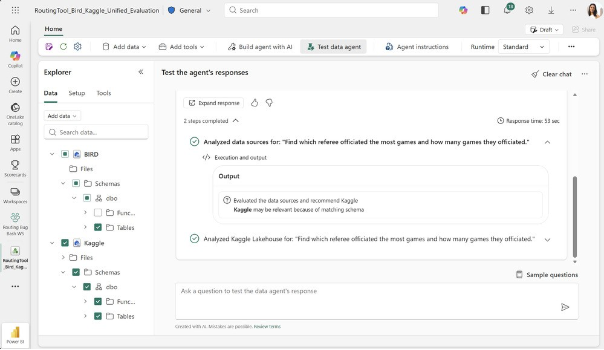
Multi-source Microsoft Fabric data agents are now Generally Available, introducing an automated routing engine that evaluates incoming plain-English questions and directs them to the correct backend data source before writing queries. By evaluating schema metadata, source descriptions, and example queries prior to execution, the platform eliminates cross-source query errors across lakehouses, warehouses, Power BI semantic models, and KQL databases. For mid-market and enterprise organisations, this provides a reliable conversational interface over complex data estates.
How intelligent source selection works under the hood
When an enterprise deploys a Fabric data agent connected to multiple storage engines, every user prompt triggers a two-stage process: routing followed by query generation. The agent's orchestrator first compares the user's intent against a curated subset of source metadata, including table structures, column definitions, and Power BI measures. If the target remains ambiguous due to schema scale or overlapping domain terms, a dedicated routing tool performs a full inspection of the registered schemas and example queries to commit to a single destination.
Once the router commits to a data source, it automatically hands off the prompt to the matching domain-specific query tool. This separation ensures that natural language is translated into the correct dialect across different engines. For lakehouses and warehouses, the platform invokes NL2SQL to evaluate tables, views, column names, and intent descriptions. For Power BI semantic models, it leverages DAX to evaluate curated measures, dimension tables, and domain descriptions. For Eventhouse KQL databases, it uses KQL to inspect event logs, time-series fields, and telemetry schemas. By isolating routing from query synthesis, the engine avoids executing invalid queries against mismatched schemas.
Eliminating quiet failures in multi-source architecture
The primary risk in conversational data interfaces is not an explicit error, but a confident answer generated from the wrong dataset. For example, asking about "checkout performance" could point to financial figures in a lakehouse, system latency in application logs, or pre-calculated KPIs in a semantic model. Routing prevents these silent misdirections by establishing strict boundaries before code generation begins.
Data platform leaders can directly shape routing precision through four operational levers:
- Schema trimming: Exposing only relevant tables and measures prevents noise from obscuring key entities during sampling.
- Intent-focused descriptions: Adding concise plain-text descriptions teaches the router the business purpose of each source beyond mere column names.
- Representative example queries: Mapping common business questions to specific sources gives the routing engine concrete patterns to match against.
- Explicit agent instructions: Setting fallback rules in the agent prompt resolves persistent domain overlaps across complex architectures.
Enterprise value and operational impact
For CDOs and enterprise data architects operating across mid-market and large organisations, this capability bridges the gap between fragmented analytical engines and self-service business intelligence. By insulating end-users from underlying platform complexity, data teams can maintain optimized, specialized storage layers without forcing business teams to know where specific metrics reside.
Learn more on Microsoft Fabric Updates Blog
Microsoft Fabric cuts compute costs and boosts enterprise scale in August 2026 update
Source: Microsoft
Microsoft Fabric has introduced major production-ready capabilities aimed at improving platform architecture, scaling high-performance workloads, and enforcing enterprise governance. Highlighting the release are the general availability of Fabric Runtime 2.0, Native Execution Engine optimizations, and production-ready OneLake resource instance rules. These updates address core infrastructure challenges, helping enterprise data leaders lower capacity consumption while expanding secure interoperability across cloud environments.
Runtime 2.0 and native execution engine shrink Spark compute bills
Data engineering teams can now leverage Fabric Runtime 2.0 (Generally Available) alongside new automatic Native Execution Engine (NEE) performance optimizations. Built on Apache Spark 4.1, Delta Lake 4.2, and Python 3.13, Runtime 2.0 upgrades the core engine foundation. Combined with NEE optimizations - such as native acceleration for ranking functions, broadcast join reuse, and automatic CTE materialization - Spark workloads now run faster with lower capacity unit (CU) consumption, requiring zero code changes from engineering teams.
For platform managers and lead engineers, this change offers immediate price-performance gains. Because these optimizations target common query patterns like large joins and complex analytical pipelines, organizations will see a direct reduction in compute overhead. Furthermore, pipeline developers gain finer execution control by overriding Spark properties directly inside the activity panel, standardizing configurations without cluttering notebook code.
Production-grade OneLake security and fine-grained data warehouse control
Securing multi-engine architectures becomes significantly easier with OneLake resource instance rules reaching General Availability. Workspace administrators can now grant precise service-to-service access to trusted Azure resource identities - such as Azure Databricks, Azure Machine Learning, and Azure SQL Server - without relying strictly on IP allowlists or complex private networking. Additionally, COPY INTO in Fabric Data Warehouse now natively supports Workspace Identities, allowing data ingestion from OneLake or ADLS Gen2 without handing users direct access to raw storage credentials.
These updates directly benefit Chief Data Officers and Security Architects focused on implementing least-privilege access and strict separation of duties. By eliminating shared secrets, SAS tokens, and service principal maintenance, enterprise teams drastically reduce their attack surface. SQL audit log noise is also minimized via new identity-based predicate filtering, allowing security operations to exclude routine system activity and focus exclusively on high-risk events.
Architectural shifts in enterprise AI and real-time streaming
Fabric Data Agents continue to mature into reliable tools for enterprise analytics. Now powered by GPT-5.1 across all runtimes and fully integrated with Microsoft Copilot Studio (GA) and Microsoft Foundry via Model Context Protocol (MCP), agents can securely query enterprise data using governed tools. Crucially, teams using the legacy OpenAI Assistants API must migrate to the MCP endpoint before August 26, 2026, to maintain uninterrupted programmatic connections. Meanwhile, Real-Time Intelligence receives a major boost with General Availability for the Eventstream MQTT connector and new Reference Data Join capabilities, enabling low-latency IoT ingestion and continuous Delta table enrichment without custom pipelines.
By grounding AI agents directly in Fabric data and simplifying real-time streaming pipelines, organizations can deliver trustworthy conversational analytics and real-time insights without building fragile custom middleware. Data platform managers gain immediate visibility into agent operational telemetry via Foundry Observability, making it simpler to debug complex multi-step workflows before pushing AI solutions into production.
Zero-friction migrations and multi-cloud data ingestion simplify integration
Data integration capabilities expand with high-value migration tools and multi-cloud streaming options. The Dataflows Upgrade Wizard (Preview) allows organizations to convert legacy Dataflow Gen1 items to Dataflow Gen2 in place, preserving existing IDs, schedules, and downstream report connections without manual rebuilds. Simultaneously, the Migration Assistant for SQL database in Fabric (GA) introduces a pre-deployment DACPAC validation tool, allowing teams to assess schema compatibility before provisioning target resources.
For hybrid data estates, Copy Job adds source support for Amazon Redshift, extended watermark-based incremental loading across engines like Databricks and Salesforce, and automated Change Data Feed (CDF) table creation. Combined with Workspace Identity support for Azure Event Hubs connections and fine-grained Workspace Outbound Access Protection (OAP) for Operations Agents, platform architects can build highly secure, scalable multi-cloud ingestion patterns while keeping network egress tightly governed.
Workspace observability and data-driven geospatial analytics streamline operations
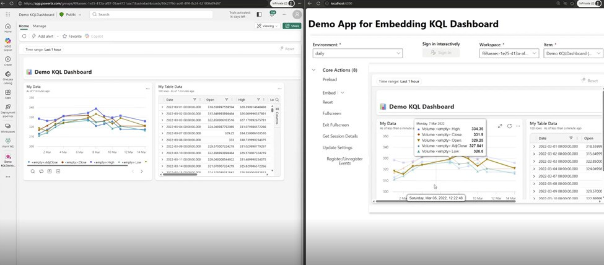
Enterprise monitoring becomes vastly more actionable with new end-to-end visibility options across Fabric items. Eventstream observability returns to Workspace Monitoring with per-stream toggles, emitting granular throughput, error, and node health metrics directly to dedicated Eventhouse tables. For complex orchestration, Data Factory's Monitoring Hub introduces Hierarchical Navigation, mapping parent-child execution relationships across pipelines, notebooks, and downstream activities to accelerate root-cause analysis during failure recovery.
On the analytics layer, Fabric Maps reaches General Availability with data-driven styling capabilities, such as color-by-value ranges, traffic flow overlays, and data-rotated markers. Embedded directly alongside in-context Eventstream alerting (GA) via Activator, operational teams can observe real-time data flows and visualize geospatial trends within a single governed environment, drastically reducing time to insight for field and business operations.
Learn more on Microsoft Fabric Updates Blog
Upgrade Power BI Dataflows Gen1 to Fabric Dataflows Gen2 with the new guided wizard
Source: Microsoft
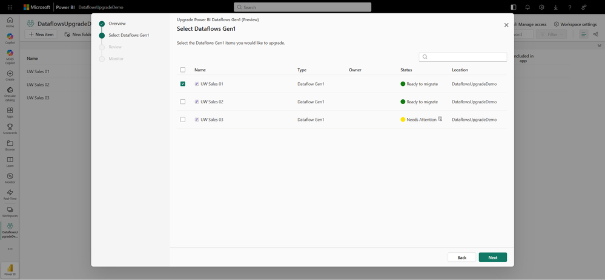
Microsoft has introduced the Dataflows Upgrade Wizard in Public Preview, giving enterprise teams a guided self-service path to migrate Power BI Dataflows Gen1 to Fabric Dataflows Gen2 (CI/CD) without rebuilding Power Query logic. By retaining existing item IDs, schedules, and connections, the wizard eliminates downstream report breakage while unlocking modern Fabric capabilities like Git integration, deployment pipelines, and advanced performance optimizations.
Streamlining enterprise modernization without breaking downstream assets
The biggest hurdle in migrating legacy dataflows has historically been the risk of breaking downstream dependencies and the manual effort required to rebuild complex transformation logic. The new Upgrade Wizard addresses this directly by preserving item IDs, refresh schedules, existing queries, and connection parameters. Downstream semantic models and Power BI reports continue pointing to the upgraded asset without requiring mass remapping across environments.
Before execution, the tool runs an automated assessment categorizing assets into clear readiness states: "Ready to migrate", "Needs Attention" (flagging items like incremental refresh, linked dataflows, or DirectQuery consumers), or "Upgrade unavailable" due to ownership constraints. This pre-flight validation allows data engineering teams to audit migration scope and sequence workloads safely across workspaces.
Unlocking developer workflows, destination flexibility, and scalable compute
Upgrading to Dataflows Gen2 transitions legacy workloads onto a modern engine built for team-based operations and enterprise scaling. Native support for Fabric deployment pipelines and Git integration brings dataflow definitions into standard source control practices. Additionally, Gen2 expands data loading destinations beyond standard storage to include Azure SQL Database, Fabric Lakehouse, Fabric Warehouse, Snowflake, and PostgreSQL.
Operational efficiency gets a major boost through features like Fast Copy, Modern Evaluator, and Partitioned Compute - delivering benchmarked refresh time improvements between 1.6x and 21x. From a cost management perspective, Gen2 introduces tiered Standard Compute pricing (offering lower rates after the first 10 minutes of execution per query), while Copilot in Data Factory accelerates logic maintenance by generating transformation steps and summarizing complex code via natural language.
Why data leadership should prioritize this migration strategy
For enterprise data leaders, this update offers a low-risk, high-return path to clear technical debt. Organizations do not need to execute a high-risk "big bang" migration; data platform managers can upgrade representative dataflows incrementally, validate runtimes, and modernize architecture at their own pace. By preserving legacy IDs while immediately gaining enterprise governance, version control, and lower execution runtimes, data teams can significantly reduce administrative overhead and compute expenditure.
Learn more on Power BI Updates Blog
Microsoft Fabric enables public-facing web applications with secure anonymous data access
Source: Microsoft
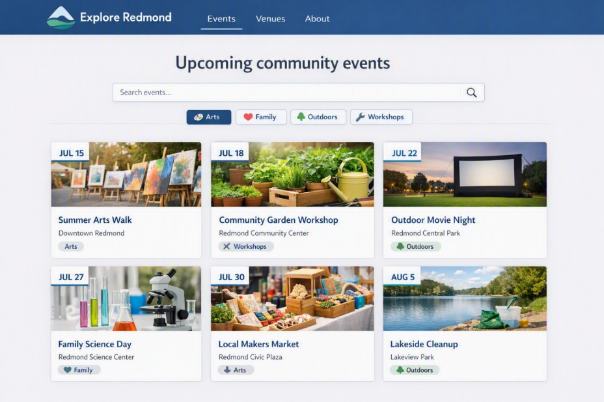
Microsoft Fabric has introduced anonymous data access in Public Preview, allowing developers to expose specific data entities to unauthenticated users without forcing every visitor to sign in. Designed for targeted public experiences like product catalogs or event registrations, this feature solves a major operational headache for enterprise teams trying to build public-facing tools on top of their central data platform. By isolating public operations from privileged actions, organizations can now expand their external digital touchpoints while keeping core enterprise assets fully protected.
Public data exposure controlled through layered enterprise governance
Rather than creating a single point of failure, authorization relies on three independent security gates: tenant-level admin controls, data-model role definitions, and entity-specific permissions. Tenant administrators retain ultimate authority, deciding which security groups can deploy public apps in the first place. App owners then explicitly opt in by decorating data entities with the anonymous role, restricting actions strictly to narrow operations like "read" for reference data or "create" for public form submissions. Because this authorization is enforced directly within the data model rather than relying solely on the front-end UI, internal controls remain intact even if an external application layer is compromised.
Balancing external reach with strict corporate security controls
Opening data access to the public internet naturally expands an organization's attack surface, making strict adherence to data governance essential. The anonymous role operates without identity claims, meaning developers must limit operations to the bare minimum required and actively suppress internal or confidential attributes from public schemas. Enterprise platform teams need to combine model-level permissions with robust input validation to guard against automated spam and unauthenticated traffic spikes. Crucially, operations omitted from the anonymous role must be rigorously tested to ensure unauthorized requests are rejected at the data platform boundary.
Unlocking lightweight public workflows without fragmenting the data architecture
For enterprise IT and data architecture leaders, this capability removes the need to deploy complex, custom middleware or secondary databases simply to support lightweight public interactions. By hosting public intake workflows and reference datasets natively within Fabric, organizations eliminate data duplication, reduce integration overhead, and streamline maintenance. It allows mid-market and enterprise firms to capture public data and serve public insights efficiently, using their existing data platform infrastructure without compromising enterprise governance or budget.
Learn more on Microsoft Fabric Updates Blog
Microsoft Fabric simplifies data warehouse migrations with IDENTITY column GA
Source: Microsoft
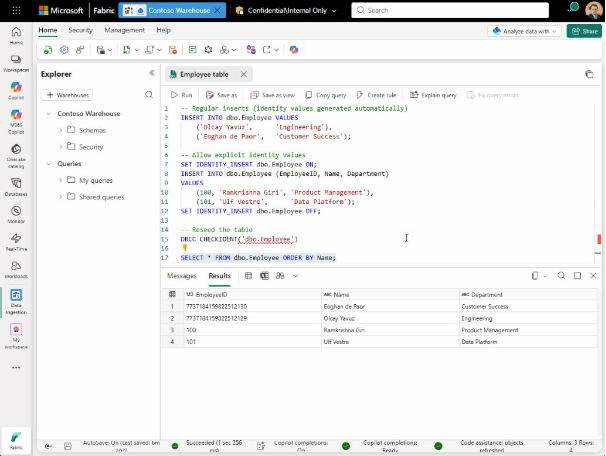
Microsoft Fabric Data Warehouse now natively supports system-managed surrogate keys with the general availability of IDENTITY columns, alongside critical bulk-loading capabilities like IDENTITY_INSERT and reseed operations. This release removes a massive technical barrier for enterprise data teams migrating legacy SQL Server, Azure SQL, or third-party data warehouses to Fabric.
Eliminating custom key generation overhead
For enterprise platform architects and lead data engineers, maintaining surrogate keys has traditionally required fragile workarounds like MAX(ID) + 1 queries, window functions, or external orchestration scripts. By shifting unique key generation to the Warehouse engine, Fabric automates identifier generation during ingestion while mitigating duplicate-key risks during concurrent loads. Because Fabric uses a distributed execution architecture, generated values are guaranteed to be unique though not strictly gap-free or sequential - a necessary design choice to preserve high-throughput ingestion performance across scale-out nodes.
Seamless historical data migration with explicit controls
The additions of IDENTITY_INSERT and reseed operations address the realistic demands of enterprise data movement. When migrating existing dimensions or running backfills, data engineers must preserve existing surrogate key relationships across fact tables. IDENTITY_INSERT enables explicit insertion of historical identifiers into an IDENTITY column, while reseed commands allow teams to reset or advance the key sequence immediately after ingestion. This provides the exact control needed to maintain downstream relational integrity without re-architecting legacy data pipelines.
This update delivers immediate ROI for organisations migrating off legacy SQL-based data platforms. By providing full parity for surrogate key management, Fabric reduces pipeline refactoring costs, speeds up migration timelines, and ensures reliable enterprise dimensional modelling at scale.
Learn more on Microsoft Fabric Updates Blog