Microsoft Fabric grounds Copilot in enterprise context and opens up agentic app development
Source: Microsoft
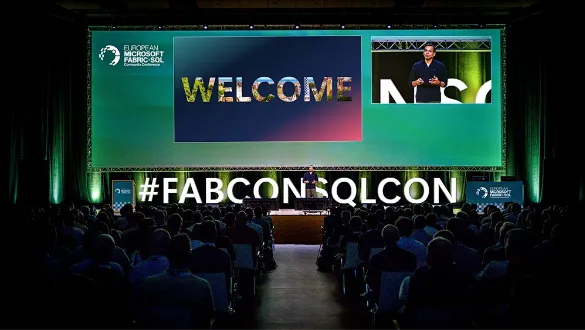
Microsoft has announced major updates to Microsoft Fabric and its data platform at FabCon and SQLCon 2026 in Barcelona. The updates focus on embedding trusted enterprise context into Microsoft Copilot through Fabric IQ, introducing agentic app development in Power BI, and giving engineering teams autonomous agents for complex data operations. For enterprise organizations, these announcements shift Fabric from a unified data lakehouse into an active intelligence layer that powers autonomous agents while strengthening governance, cross-cloud interoperability, and database estate management.
Fabric IQ bridges the gap between enterprise data and Microsoft Copilot
The biggest hurdle for enterprise AI adoption has been providing models with reliable, governed business context. Through Fabric IQ, Microsoft is integrating trusted Power BI semantic models, metrics, and organizational ontologies directly into Microsoft Copilot Chat and Cowork experience at no additional token cost. This allows business leaders and knowledge workers to query core operational metrics using natural language while guaranteeing the answers match official corporate definitions.
By standardizing business logic across Microsoft OneLake and Copilot, IT leaders avoid the risks of fragmented AI outputs. Fabric IQ acts as a unified semantic layer, ensuring that whether an employee queries a dashboard or asks Copilot a natural language question, the underlying business logic remains consistent, secure, and fully governed.
Power BI evolves into an agentic app builder with native SQL backend
Power BI Desktop is expanding beyond report creation to support agentic application development. Using natural language, teams can build custom business applications that write back data, manage state, and drive operational workflows directly from trusted semantic models. Behind the scenes, these applications leverage Fabric Apps and come provisioned with a dedicated SQL database in Fabric, built-in security, and user authentication.
This capability lowers the barrier to turning insight into operational action without creating shadow IT. Because these apps are backed by enterprise-grade Fabric infrastructure, Power BI Pro and Premium Per User accounts receive access to up to 1 GB per app at no extra charge. When applications scale, pro-developer teams can take ownership using the open-source Rayfin SDK, GitHub Copilot, or VS Code, eliminating traditional friction between citizen development and enterprise application maintenance.
Autonomous agents transform data engineering and database management
For technical teams, Microsoft is introducing autonomous data engineering agents and unified database management. Built on technology from the Osmos acquisition, the new data engineering agent executes long-running data migrations, lakehouse modernizations, and ETL pipelines based on outcomes defined by engineers. In parallel, the new Database Hub in Fabric provides a centralized control plane across SQL Server, Azure SQL, PostgreSQL, and Cosmos DB, supported by specialized database agents that identify performance bottlenecks and automate troubleshooting.
These platform advancements significantly reduce the operational overhead of running complex data architectures. Enterprise data engineers shift from executing manual transformations to orchestrating autonomous systems, while database administrators gain cross-estate visibility and automated optimization tools. Additionally, new observability features in Fabric, combined with on-demand billing, give organizations greater cost visibility and resource elasticity.
Unifying data estates across hybrid clouds and open standards
Fabric is also expanding its open ecosystem capabilities through IQ sharing and deeper cross-platform integrations. Organizations can now securely share governed data products, Markdown agent instructions, and ontologies across organizational boundaries. Multi-cloud architecture support has been strengthened with bidirectional Salesforce Data Cloud 360 integration, general availability of Google BigQuery mirroring, and alignment with Apache Ossie (incubating) alongside Snowflake to support open semantic metadata standards.
For enterprise architects and CDOs, these updates prove that Microsoft Fabric is maturing into a scalable, secure foundation for enterprise AI. By enabling seamless context sharing across platforms and giving teams the tools to build agentic workflows, Fabric helps mid-market and enterprise organizations shorten the time from raw data collection to production-ready AI outcomes.
Learn more on Microsoft Azure Blog
Fabric Data Factory updates at FabCon Barcelona 2026: Bridging multicloud data silos for enterprise AI
Source: Microsoft
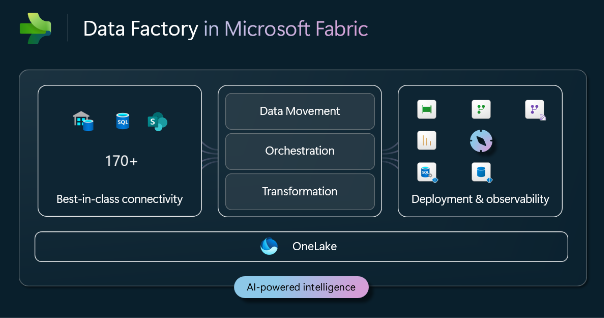
Microsoft Fabric Data Factory has expanded its capabilities with over 45 updates presented at FabCon Barcelona 2026. The platform now delivers broader cross-cloud replication, automated security policy transfer, zero-ETL integrations, and enhanced pipeline orchestration to help enterprise teams eliminate data fragmentation across complex hybrid environments.
Unifying hybrid data estates with extended Mirroring and zero-ETL integration
Data silos remain a persistent bottleneck for enterprise AI deployment. Microsoft addresses this by extending Fabric Mirroring to critical analytical and operational data sources. Mirroring for Google BigQuery and SharePoint Lists has reached general availability, allowing organizations to bring both large-scale analytical data and working business lists into OneLake without building complex ETL pipelines or overloading source systems. Support for Dynamics 365 Business Central is slated to follow shortly.
Crucially for security teams, Extended Capabilities in Mirroring now include automatic replication of Snowflake security policies alongside Change Data Feeds. Instead of manually recreating governance rules and access controls in OneLake, security roles now travel directly with the data. This eliminates redundant administrative overhead and ensures consistent data governance across multicloud architecture.
Streamlining cross-cloud data movement with modern Copy job capabilities
Enterprise architectures frequently require distributing data to external systems, partners, or customer environments. The updated Copy job feature addresses this need by combining batch and streaming paradigms, allowing historical and change data to be written directly into eventstreams. With new support for Fabric Activator triggers, data movement can respond dynamically to system events rather than relying solely on fixed clock schedules.
Multicloud distribution is further strengthened by support for SharePoint folder destinations and multi-folder loading within a single execution. For teams operating across diverse cloud platforms, custom staging database configurations offer finer control over CDC and SCD Type 2 objects, ensuring data delivery strictly aligns with internal security practices. Centralized workspace monitoring provides a single view of job health and throughput to simplify day-to-day operations.
Extending orchestration resiliency, governance, and low-code transformation
Fabric Data Factory pipelines, which handle over 25 billion monthly runs, gain several operational upgrades. The new Lakehouse Maintenance activity allows teams to automate vacuum and optimize tasks directly within data pipelines to maintain performance without separate job management. Pipelines also introduce exponential retry logic to handle transient system throttling and support workspace identity or service principals for Outlook notifications, preventing failure risks associated with individual user accounts.
On the transformation front, Dataflow Gen2 now features Shared Queries for reusable business logic, V-Order compression controls, and direct delivery options to business tools like Excel and email. For code-first engineering teams, dbt Job in Fabric is generally available, writing run history and execution logs straight to OneLake for centralized telemetry and compliance auditing.
Operational efficiency and strategic impact for enterprise platform teams
For enterprise data leaders, these updates lower the integration tax required to support corporate AI initiatives and cross-cloud operations. Automated security role replication and native workspace monitoring reduce manual administrative effort, while zero-ETL options accelerate time-to-insight for operational analytics. By streamlining migration paths for existing Azure Data Factory workloads and unifying low-code and pro-code workflows, organizations can modernize their data estates while preserving existing infrastructure investments.
Learn more on Microsoft Fabric Updates Blog
Microsoft Fabric introduces enterprise-grade observability, deployment plans, and zero-provisioned compute
Source: Microsoft
Microsoft Fabric has expanded its enterprise capabilities with cross-workspace observability, automated deployment plans, attribute-based governance policies, and zero-provisioned compute. These updates address critical operational bottlenecks for large organizations, enabling data teams to deploy workloads predictably, trace cross-workspace pipeline failures, and optimize compute costs dynamically.
Unifying operational visibility across complex data estates
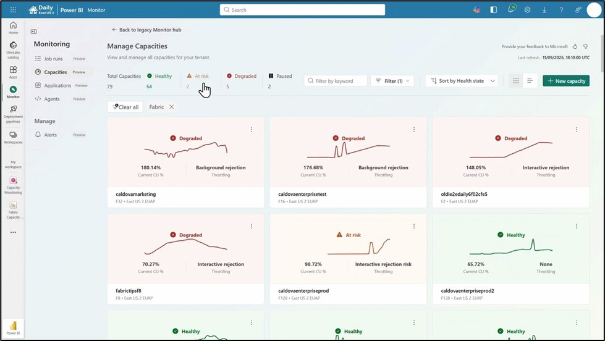
Enterprise data architectures often fragment operational telemetry across isolated workspaces, making root-cause analysis difficult when complex pipelines fail. The preview of unified workspace monitoring solves this by allowing teams to stream operational logs, job signals, and capacity metrics into a single, centralized Eventhouse.
Supported by a refreshed Monitor Hub and AI-driven operations agents via Activator, engineers can correlate cross-boundary failures, assess resource pressure alongside job failures, and run agentic investigations automatically.For Data Platform Managers and Lead Data Engineers, this eliminates manual log assembly and shortens mean time to recovery (MTTR). External observability tools can also ingest this telemetry via public APIs and custom Eventstream endpoints.
Eliminating deployment friction with workspace-as-code and delegated branching
Moving data solutions from feature branches to production often suffers from manual handoffs and inconsistent environment configurations. Fabric now introduces deployment plans (Preview), featuring visual canvases backed by YAML as the single source of truth to define exact execution orders, including pre- and post-deployment validation steps.
To streamline team workflows without compromising governance, administrators can delegate branch workspace creation using controlled profiles that predefine roles, capacity allocations, and security boundaries.
Combined with the general availability of Bulk Item Definition APIs, selective branching, and granular file-level Git commits, enterprise teams can treat Fabric infrastructure strictly as code while giving developers safe sandboxes to experiment.
Strengthening enterprise governance without blocking developer velocity
As AI tools expand data access across the business, traditional workspace-level controls often prove too coarse for complex compliance requirements. The new preview of policies in Fabric introduces attribute-based access control (ABAC) anchored in the OneLake catalog, allowing tenant admins to enforce granular rules around item creation and security based on user traits and data sensitivity.
This central governance experience is further enhanced by AI-powered Govern Skills within skills-for-fabric, offering automated risk identification and actionable health recommendations. Network security also gets an upgrade with expanded Outbound Access Protection across shortcuts and operations agents, alongside FQDN allowlisting for Spark, drastically reducing the need to provision dedicated Private Endpoints for every external dependency.
Flexible compute models cut idle costs and simplify entry
For Chief Data Officers and IT Directors managing platform spend, balancing peak performance with idle capacity costs is an ongoing challenge. Fabric is rolling out on-demand compute billing and zero-provisioned capacity (F0), allowing organizations to run workloads without upfront capacity reservations and pay strictly for consumed resources.
For mission-critical workloads, workspace-level surge protection (GA) prevents runaway queries from throttling key business processes, while capacity overage settings and larger SKUs (F4096 and F8192) provide reliable burst capacity. These financial controls, integrated into the refreshed Monitor Hub alongside enhanced metrics apps, give organizations total transparency over resource allocation and chargebacks.
These updates transform Microsoft Fabric from a collection of powerful analytics tools into a mature, production-ready enterprise data platform. By embedding automated deployment pipelines, proactive capacity controls, and centralized governance directly into daily engineering workflows, enterprise leadership can scale AI and data initiatives rapidly while keeping operational risk, security compliance, and platform costs under tight control.
Learn more on Microsoft Fabric Updates Blog
Microsoft Fabric expands Fabric Apps with serverless functions and managed databases to bridge the execution gap
Source: Microsoft
Microsoft has introduced major updates to Fabric Apps, transforming its application layer into a full-stack development surface with serverless backend functions, managed PostgreSQL, built-in storage, and direct data connectors.
For enterprise data leaders, the primary challenge of modern data architecture has shifted from insights generation to execution. While Power BI semantic models and reports deliver trusted insights, translating those insights into operational action traditionally requires building custom applications from scratch. This process involves provisioning external infrastructure, managing database connections, copying data, and traversing complex security and governance reviews. Fabric Apps solves this "last mile" problem by enabling teams to build secure, data-rich applications directly on top of managed Fabric artifacts without duplicating underlying data.
Code-first Rayfin framework streamable directly from TypeScript to governed production
At the core of Fabric Apps is Rayfin, a code-first development framework using TypeScript. Developers or AI coding agents can describe application logic, data schemas, storage buckets, and identity rules within a unified source repository. Using the Rayfin SDK and CLI, teams run applications locally before deploying them directly into the Fabric platform, where storage, secret management, compute scaling, and authentication are automatically provisioned and governed.
By keeping the application definition entirely in code, enterprise platform teams maintain total visibility over runtime state and requested permissions. This setup prevents shadow IT deployments while accelerating time-to-market for business-led initiatives.
Native data connectors and PostgreSQL support eliminate redundant data pipelines
Fabric Apps now connects directly to Fabric SQL Databases, Warehouses, Lakehouse SQL endpoints, and Power BI semantic models. Crucially, the platform eliminates the need to copy enterprise data into separate app databases. Applications query existing semantic models directly to reuse approved metrics, such as revenue and target definitions, ensuring single-source-of-truth accuracy across reports and operational interfaces.
For operational state, such as storing approvals, user notes, or workflow status, Fabric Apps adds managed PostgreSQL support alongside SQL Server. Schema definitions ship with the application code, removing connection string management and rogue migration scripts. Supplementary files like PDF contracts, images, or transcripts are managed via code-defined storage folders with automatic pointer links in the database.
Built-in backend functions and enterprise-grade security controls
To handle business rules, AI calls, and external API integrations, developers can write serverless backend functions in TypeScript hosted natively inside Fabric. Backend functions run using app identity or can forward the signed-in user context to downstream sources. Sensitive keys are stored in a managed Secret Store, preventing credentials from leaking into source control or deployment pipelines.
Enterprise security architectures remain intact: Entra ID authentication occurs before application assets load, blocking unauthenticated access at the edge. Crucially, Fabric Apps keeps application-level authentication separate from Fabric data authorization, ensuring row-level security (RLS) is strictly enforced at the data source when using delegated queries. Built-in telemetry tracking query duration, error rates, and user sign-ins provides platform teams with immediate visibility into performance and adoption without requiring external monitoring tools.
Fabric Apps provides enterprise data leaders with a governed method to close the loop between data analytics and business action. By removing infrastructure provisioning barriers while enforcing native governance, mid-market and corporate organizations can safely empower business teams to convert static reports into active operational software.
Learn more on Microsoft Fabric Updates Blog