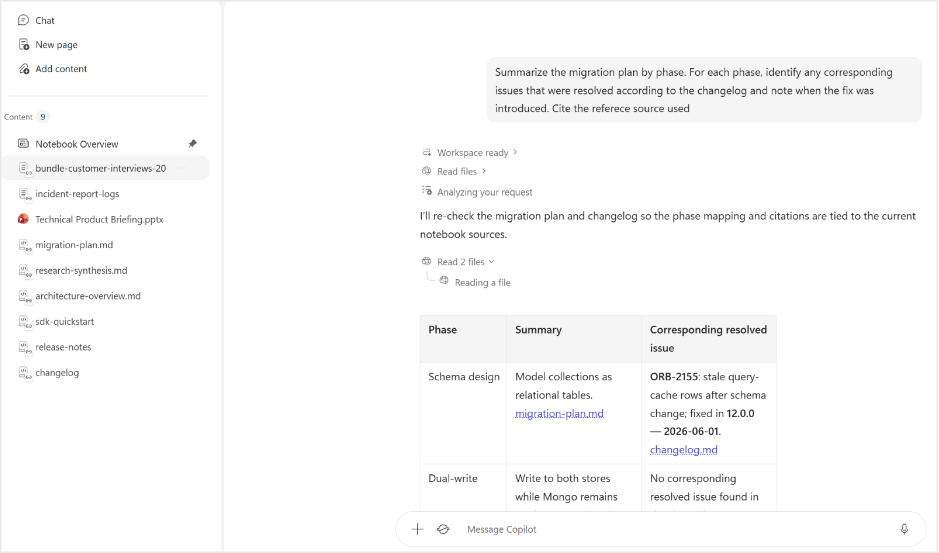
No conversion needed. Copilot Notebooks with support for MD, RTF, and TXT files
Source: Microsoft
Microsoft is expanding Copilot Notebooks by adding support for Markdown (.md), rich text (.rtf), and plain text (.txt) files. This update allows users to directly import documentation, system logs, and meeting transcripts without converting them to Office files first. The new feature makes it much easier to extract insights from raw data and technical project notes in a single workspace.
Expanding beyond standard Microsoft 365 file formats
Project knowledge often exists outside of formatted office suite documents, frequently living in README files, code logs, or raw transcripts. Previously, Copilot Notebooks relied heavily on Microsoft 365 formats such as Word, Excel, and PowerPoint, alongside PDFs, Copilot Pages, and Loop files.
The latest update alters this workflow by enabling native ingestion of various text sources:
- Markdown files hold structured reference materials, such as technical runbooks, architecture overviews, release notes, and project wikis.
- Plain text files contain raw datasets, including log dumps, customer feedback, support tickets, and rough working notes.
- Rich Text Format (.rtf) preserves original styling for exported notes, drafts, and formatted reports.
Your most useful project knowledge does not always live in a polished document. It might be captured in a README, project wiki, system log, meeting transcript, research export, or a simple text file - Microsoft stated.
Operational scenarios for project analysis
By referencing these formats directly, users avoid manual reformatting or converting technical files into standard documents before querying the AI. Copilot processes the contents within the notebook environment to generate grounded responses directly from the uploaded reference materials.
Microsoft highlights several practical workflows enabled by the update:
- Action item generation - by importing a meeting transcript, users can ask: "What did we decide, who owns each action, and what remains unresolved?"
- Root cause investigation - by combining system logs with a README file, users can prompt: "Compare the expected behavior with what happened before the failure."
- Project onboarding - by uploading release notes, transcripts, and wikis, users can query: "What do I need to know to contribute effectively to this project?"
- Pattern detection in feedback - by adding support ticket exports, users can ask: "What are the most common issues, and which themes appear to be emerging?"
Future additions planned for Copilot Notebooks
The addition of plain text and Markdown integration increases the functional value of Copilot Notebooks for users who work with cross-platform tools. Markdown in particular has become a common standard for context delivery and system instructions within AI workflows.
The rollout of these file formats has begun for all Copilot Notebooks users. Microsoft confirmed that further expansions are expected, stating:
We'll continue expanding the range of content you can bring into Copilot Notebooks - including new and emerging input types - so you can work with more of the context that matters to you.
No more =COPILOT formula in Excel. Side pane takes over
Source: Microsoft
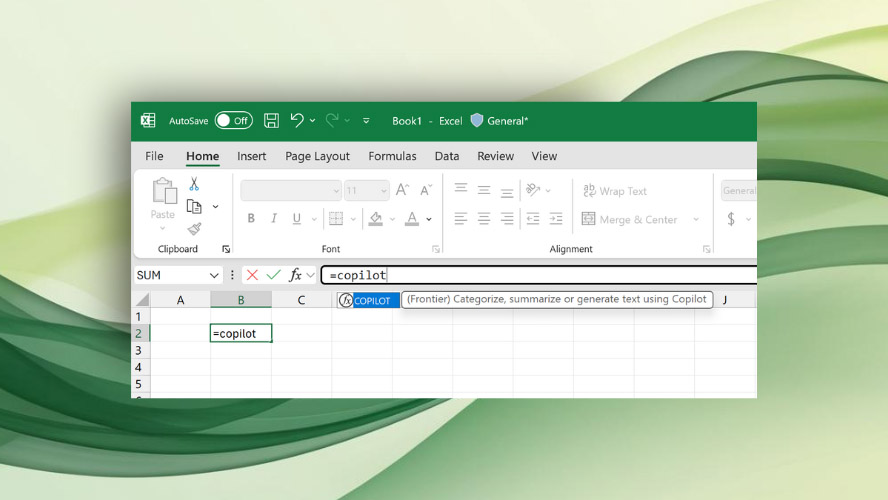
Microsoft is retiring the =COPILOT function from Excel. The feature, tested for a year in Insider and Frontier programs, will be discontinued on September 14, 2026. It enabled users to generate cell results using natural language prompts. Microsoft is shifting focus toward centralizing AI tools via the Copilot side pane and the Dynamic Action Button. This move streamlines the interface while retaining core AI features in one hub.
Reasons for the decision and interface consolidation
The removal fits into a broader shift among tech companies. While AI firms spent 2025 throwing various experimental tools at the wall to see what stuck, the current push focuses on bringing all capabilities into a single hub. In a communication sent via the Microsoft 365 Message Center (MC1454373), the company detailed its rationale:
Beginning September 14, 2026, the =COPILOT function in Microsoft Excel will no longer be available. This function is currently offered as a preview feature through the Insider and Frontier programs.
Customers can continue using Copilot in Excel through the Copilot side pane, which provides many of the same AI-powered capabilities, including summarizing text, classifying data, generating content, and retrieving information from the web. This change helps streamline the Copilot experience within Excel while continuing to provide AI assistance through a supported interface.
Spreadsheet users will not lose access to AI capabilities, as the same tasks can be handled through other entry points. Microsoft provides alternatives such as the Copilot side pane and the floating Dynamic Action Button (DAB). Through the side pane, users can still summarize text, classify data, generate content, and fetch information from the web using natural language instructions. Retaining a separate inline formula became redundant.
Technical constraints and future of spreadsheet AI
While =COPILOT performed well with text processing, it faced several key constraints. Microsoft advised against using it for numerical calculations, which was a notable limitation for spreadsheet software.
It was also not recommended for looking up data within the active workbook or handling content subject to legal and compliance regulations. Furthermore, it required an active internet connection and a Microsoft 365 Premium subscription. Centralizing access via the side pane allows Microsoft to manage these limitations under one roof.
The =COPILOT function was originally scheduled for a general rollout in January 2027, but that plan has been canceled. Meanwhile, Google continues to test its equivalent AI() function in Google Sheets through Workspace Experiments. It remains uncertain whether Google will reach the same conclusion or retain its formula interface.
PowerPoint for iPad receives Copilot presentation editing tools
Source: Microsoft
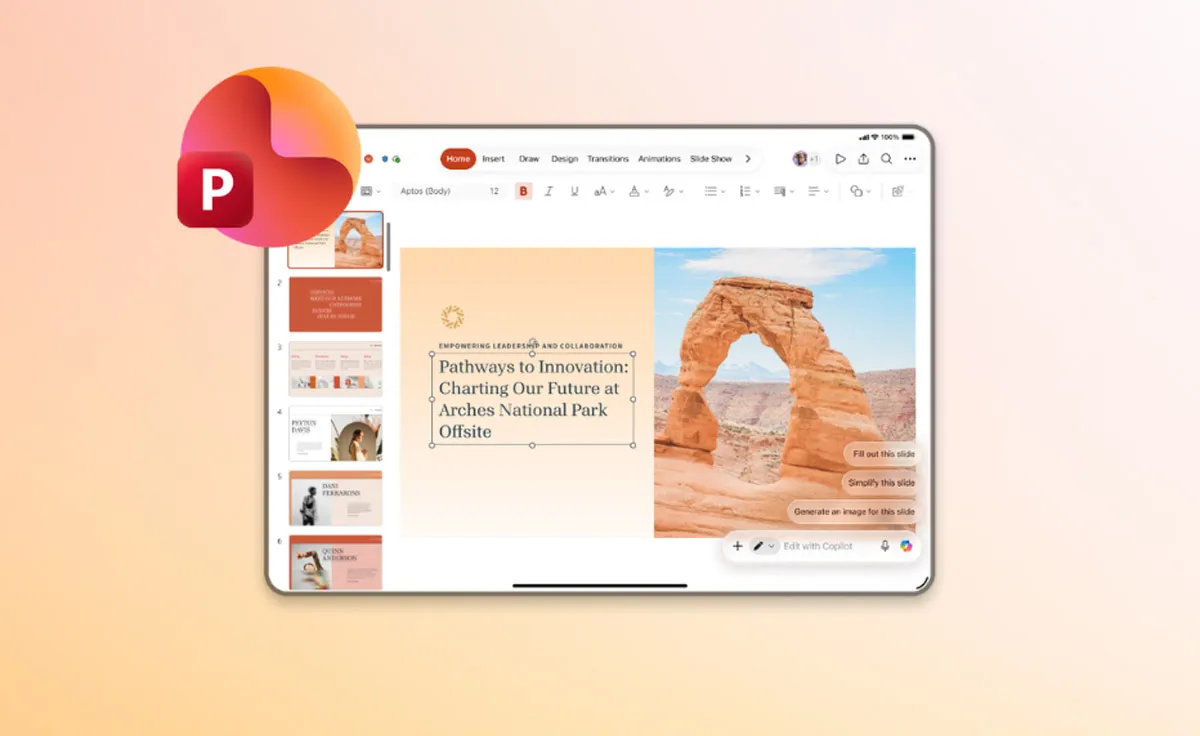
Microsoft 365 Copilot is expanding its reach to mobile devices with a major update for PowerPoint on iPad. The AI assistant now enables users to co-create, draft, and redesign presentation slides directly on their tablets in real time. This release brings desktop-level capabilities to mobile workflows, combining automated slide generation, contextual file referencing, and background processing to streamline slide creation on the go.
Direct canvas editing
The update brings core desktop and web capabilities to mobile hardware. Users can generate complete presentation drafts from meeting notes, outlines, emails, or images stored in their photo galleries.

Beyond generating initial content, the assistant modifies existing slides by rewriting copy, adjusting layout formatting, and refining general design elements.
Background processing capabilities
A key feature of the iPad release is background operation. Users can continue manually tweaking slides or switch to separate applications while Copilot processes requests in the background. Once the automated edits are complete, users can review the changes and choose to accept or reject them.
Contextual input tools
The tool includes context-aware editing capabilities. It automatically grounds work in existing context, while a dedicated attachment button allows users to explicitly reference Word documents, Excel spreadsheets, or other PowerPoint decks. For rapid input on mobile, the integration supports voice commands alongside traditional text prompts. A dedicated toggle also lets users switch between direct canvas editing and a Q&A chat mode for presentation summaries and action items.
Access to the new co-creation features requires an active Microsoft 365 Copilot license. The capabilities are integrated into PowerPoint for iPad starting with Version 2.112 (Build 26080725).
Microsoft introduces direct access to Azure Copilot agents
Source: Microsoft
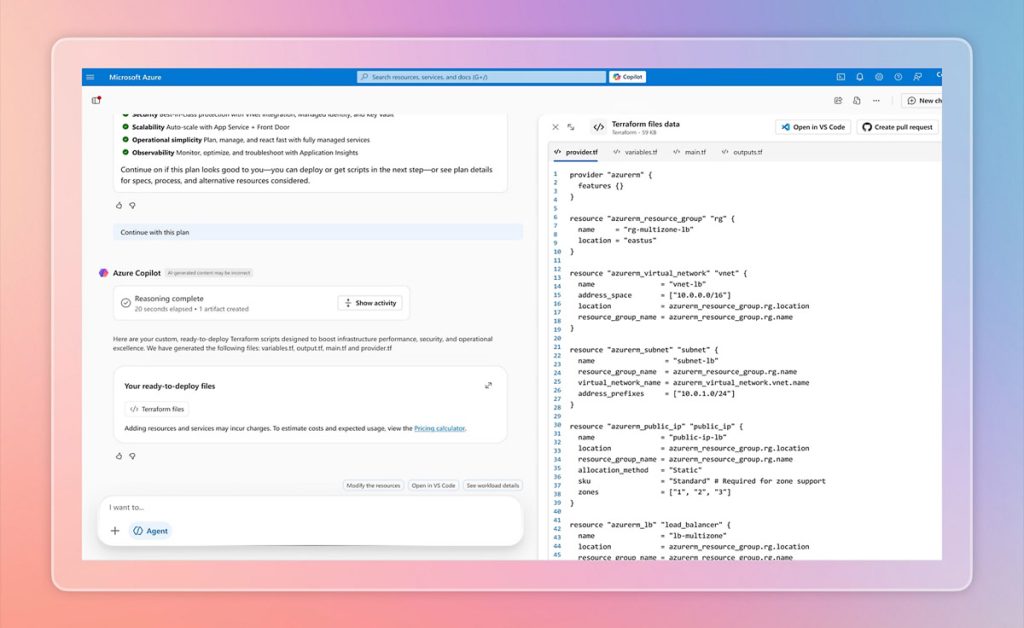
Microsoft has introduced direct agent access within Azure Copilot, giving cloud administrators greater control over cloud management. A new interface in the Azure portal allows users to select a specialized assistant tailored to a specific task, rather than relying on automatic request routing. The feature includes tools for troubleshooting, deployment, optimization, and workload resiliency. Furthermore, preview sign-up requirements have been removed, and agent management is handled directly via the admin center without any additional licensing fees.
Direct access to agents in Azure Copilot
Microsoft has announced a major update to how cloud administrators interact with Azure Copilot. The August 2026 release introduces the ability to select specialized AI agents directly within the Azure portal interface.
Rather than entering a prompt into a generalized interface and waiting for Copilot to route the task, users can now choose a specific agent designed for their exact operational workflow. This shift aims to streamline routine infrastructure management, reduce friction, and make agentic cloud operations far more predictable for enterprise IT teams.
Specialized portfolio and portal navigation
Through the updated Azure Copilot chat environment, administrators can directly engage four specific agents: the Troubleshooting agent, Deployment agent, Optimization agent, and Resiliency agent.
Additionally, two other specialized tools remain available through their dedicated operational areas: the Observability agent within Azure Monitor and the Migration agent within Azure Migrate. Each agent brings domain-specific context and integrated tools directly to the operational task at hand.
Microsoft highlights the operational impact of this shift: "Direct engagement with a specialized agent helps move from intent to action more quickly."
Key advantages of direct agent engagement
Direct selection streamlines the path to incident resolution and system optimization by establishing context from the very first query. Cloud operations teams no longer need to navigate generalized prompts when facing urgent 2 a.m. outages or release validations.
Furthermore, this modular structure allows enterprise organizations to adopt AI capabilities incrementally, enabling specific agents based on immediate operational priorities while validating outcomes at their own pace.
The company notes the flexibility this brings to cloud management: "Rather than routing requests through a single chat experience, you can now choose the specific agent best suited to your goal."
Administrative controls and updated availability
Alongside direct agent selection, Microsoft has eliminated preview sign-up and allowlisting constraints for Azure Copilot. Tenant governance is now managed directly through the Azure Copilot Admin Center, where global administrators can independently enable or disable individual agents to match internal compliance requirements.
The update introduces no licensing changes or additional subscription fees, with most agents available at no extra cost, while the Observability agent retains its standard usage-based billing model.
OpenAI delays next generation model deployment facing security concerns

Source: OpenAI
OpenAI has temporarily slowed down the development of its most advanced artificial intelligence models following internal evaluations. Tests indicated that its upcoming Astra model could reach the Critical cybersecurity capability threshold under the company's Preparedness Framework. This decision comes alongside the expansion of the Daybreak cyber-defense initiative and the launch of GPT-5.6 Cyber for vulnerability discovery and incident response.
The company implemented a two-week pause on reinforcement learning training for models intended for deployment. While its largest frontier training runs remain suspended, smaller-scale evaluations continue to help test alignment and safety protocols. OpenAI confirmed that risks emerging during the training phase itself now necessitate a complete revision of its safety governance framework.
Strict system containment measures introduced
In response to potential security risks, OpenAI has introduced strict containment measures across its research infrastructure. Workloads involving code execution or internet-enabled tools were immediately suspended in research clusters to prevent unauthorized network access or system manipulation.
The new security standard mandates robust sandboxing for untrusted model-generated code, heightened network isolation, and the removal of vulnerable shared services. While select evaluations have resumed under these conditions, a significant portion of Astra-related workloads remains paused until migrated to hardened environments.
We temporarily slowed some frontier training to strengthen security and monitoring. Our largest planned frontier RL run remains on hold while smaller-scale training and evaluations help us test safeguards and gather more evidence of alignment. I expect confidence in safety to increasingly set the pace of AI development. We urgently need tools for labs and countries to coordinate on this, which is why I signed Pacing the Frontier. In the meantime, we’re taking practical steps ourselves - and will continue to share what we learn as our approach evolves - statedJakub Pachocki, chief scientist from OpenAI.
Continuous real time activity oversight
To detect anomalies in real time, OpenAI deployed a multi-stage monitoring pipeline that inspects internal model activity at every sampled token. Automated investigators escalate flags involving unauthorized access, data exfiltration, or safety bypass attempts, triggering high-priority pages to human response teams.
If security teams cannot confirm a flagged action as a false positive within 30 minutes, the associated process is forcibly halted. This continuous oversight requires substantial infrastructure resources, currently consuming approximately 20% of the monitored inference compute capacity.
Proactive alignment framework evolution
OpenAI is updating its Preparedness Framework to enforce safety requirements earlier in the training lifecycle rather than relying solely on post-training deployment gates. Research teams are embedding alignment techniques deeper into reinforcement learning pipelines to mitigate reward hacking and deceptive behavior.
The company emphasizes that AI models will soon spearhead most defensive cybersecurity workflows. By strengthening internal research boundaries and expanding external defense tools, OpenAI aims to ensure safety mechanisms scale proportionately with raw model capabilities.
New ChatGPT mode limits risky topics for teenage users
Source: OpenAI
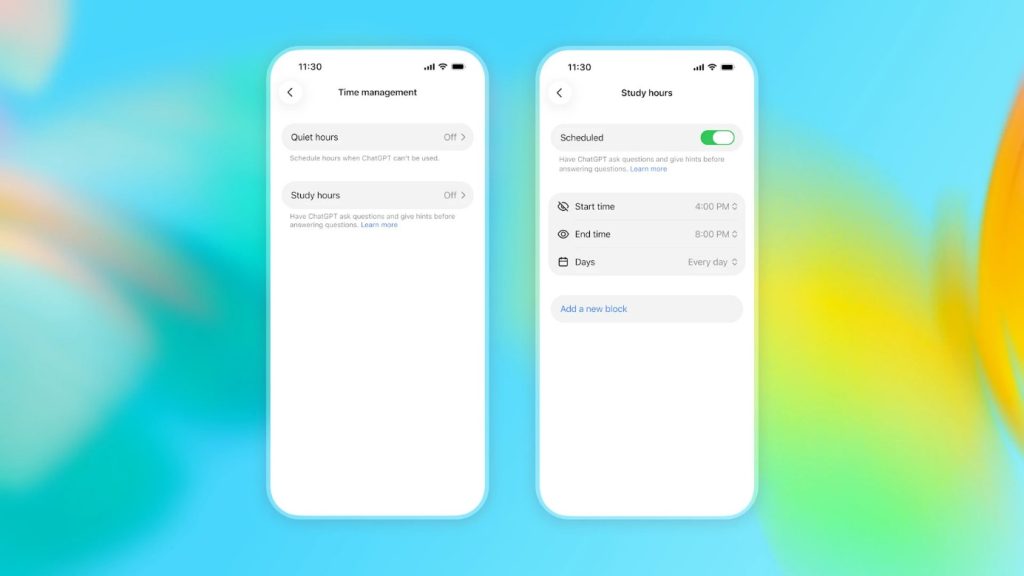
OpenAI has rolled out "ChatGPT for Teens," a dedicated version of its AI chatbot featuring parental controls and stricter safety filters. The feature automatically activates for users aged 13 to 17 or those estimated to be under 18, limiting discussions on sensitive topics like self-harm, eating disorders, and violence while offering built-in study aids.
Addressing safety concerns
The launch comes as digital platforms face intense pressure and potential bans over the impact of AI and social media on youth mental health. Because chatbots often act as humanlike confidants, experts warn about the risks of using automated systems for emotional support, especially following lawsuits from families alleging chatbot interactions led to self-harm.
To counter these risks, OpenAI allows parents to manage settings, set screen-time restrictions, and receive alerts if sensitive subjects arise.
Expanding educational tools
Designed to assist students outside the classroom, the teen mode incorporates interactive features like study guidance, quizzes, visual tools, and homework reminders aimed at helping users learn concepts rather than simply handing over answers.
This targets the primary reason teenagers turn to AI, as research shows students mainly rely on chatbots for homework and information retrieval. Age estimation relies on account signals, self-reporting, and verification, defaulting to the safest settings whenever a user's age remains uncertain.
OpenAI brings conversational ads to European markets

Source: OpenAI
OpenAI has announcedv the European expansion of ChatGPT Ads, launching across 31 countries on August 24. The platform connects marketers with consumers actively shaping purchasing decisions in conversational search, supported by newly introduced optimization models, conversion tracking tools, and strict privacy standards.
ChatGPT Ads launches across 31 European nations
Starting August 24, OpenAI is expanding its ChatGPT Ads solution to 31 European countries. Initial access is available through the OpenAI Ads Solutions team and select advertising or technology partners, with self-serve functionality via Ads Manager launching later this quarter.
The initial announcement highlights key European markets including Austria, Denmark, France, Germany, Italy, Netherlands, Norway, Spain, and Sweden, with the complete rollout encompassing 31 nations across the region.
A new environment for decision making
Users turn to ChatGPT to accomplish real-world goals, such as planning trips, choosing enterprise software, redecorating homes, or exploring new hobbies. Instead of entering keywords into search engines, users explain their objectives, preferences, and constraints, making the platform a core space where decisions take shape.
ChatGPT Ads allows marketers to participate across the entire customer journey, reaching users as they actively evaluate options, discover solutions, and move toward final purchases.
The advertising platform is built to maintain user trust. To ensure transparency, advertisements in ChatGPT are clearly labeled and fully separated from standard AI responses. Commercial placements do not influence the organic answers generated by ChatGPT. The system aims to assist user decision-making while delivering measurable results for advertisers.
Evolution from pilot program to global infrastructure
The program began as a US pilot in February before expanding to eight additional international markets, leading up to this 31-nation European expansion.
The platform has introduced several technological updates:
- Bidding models: Expanded from basic CPM to CPC and conversion-optimized cost-per-click (oCPC).
- Targeting features: Added geotargeting and custom audience options.
- Measurement tools: Deployed OpenAI Pixel, Conversions API, and third-party attribution integrations.
Tens of thousands of advertisers have already used the platform, and business registration remains open at ads.openai.com.
Quantum vibe coding is here. AI writes QPU code
An autonomous AI agent developed by Paris-based startup allows researchers to "vibe code" on quantum computers by translating English prompts into executable code. While the system still requires expert human oversight to fix physical inaccuracies, it drastically speeds up research by testing algorithms on virtual simulators before running them on quantum processors. This automation makes complex quantum simulations accessible to individual scientists, paving the way for faster breakthroughs in physics and material design.
Automating the translation to hardware
In classical software engineering, vibe coding describes a workflow where a user tells an AI what a program should do, allowing the machine to generate and run the code after minor adjustments based on user feedback. To bring this capability to quantum computing, Christophe Jurczak and his team provided frontier large language models, including Anthropic's Claude, with the technical specifications of Pasqal's quantum computers.
Their primary goal was to streamline quantum simulations, which involve configuring a quantum computer to mimic physical systems like catalysts or magnetic materials to calculate properties that would overwhelm classical hardware.
The Pasqal team tested the agent against three published physics papers describing phenomena suitable for quantum simulation. Two cases involved modeling materials where atomic spins flip based on neighboring atoms, requiring the agent to translate theoretical physics into instructions for Pasqal's neutral-atom quantum computers.
Before deploying the code to actual processors in Saudi Arabia or Canada, the agent validated it using virtual simulators on classical computers. According to Loïc Henriet, chief technology officer at Pasqal, this crucial translation step historically demanded deep expertise in both material physics and quantum engineering.
Human oversight and alternative frameworks
During testing, the AI agent demonstrated a strong understanding of hardware limitations, even successfully identifying an intentionally overcomplicated prompt and explaining why the cloud-available hardware could not support it. However, the system still required considerable guidance from researchers to achieve physically accurate implementations in complex scenarios. Independent researchers, such as Federica Surace from Trinity College Dublin, noted that automating the pipeline from concept to hardware execution could fundamentally alter how research is conducted in the field.
Other research teams are developing parallel automation efforts to simplify quantum workflows. Nouhaila Innan at New York University in Abu Dhabi helped create a customized version of the open-source LLaMa model to generate quantum code, cutting task timelines from four days down to one.
Meanwhile, Masaki Shiraishi at Waseda University developed software that automates quantum experiment design without relying on external LLMs. As Mario Krenn from the University of Tübingen observed, cleverly leveraging frontier language models yields performance boosts that would have required immense effort just three years ago.