

Copilot turns conversations into action. Convert chats into work tasks
Source: Microsoft
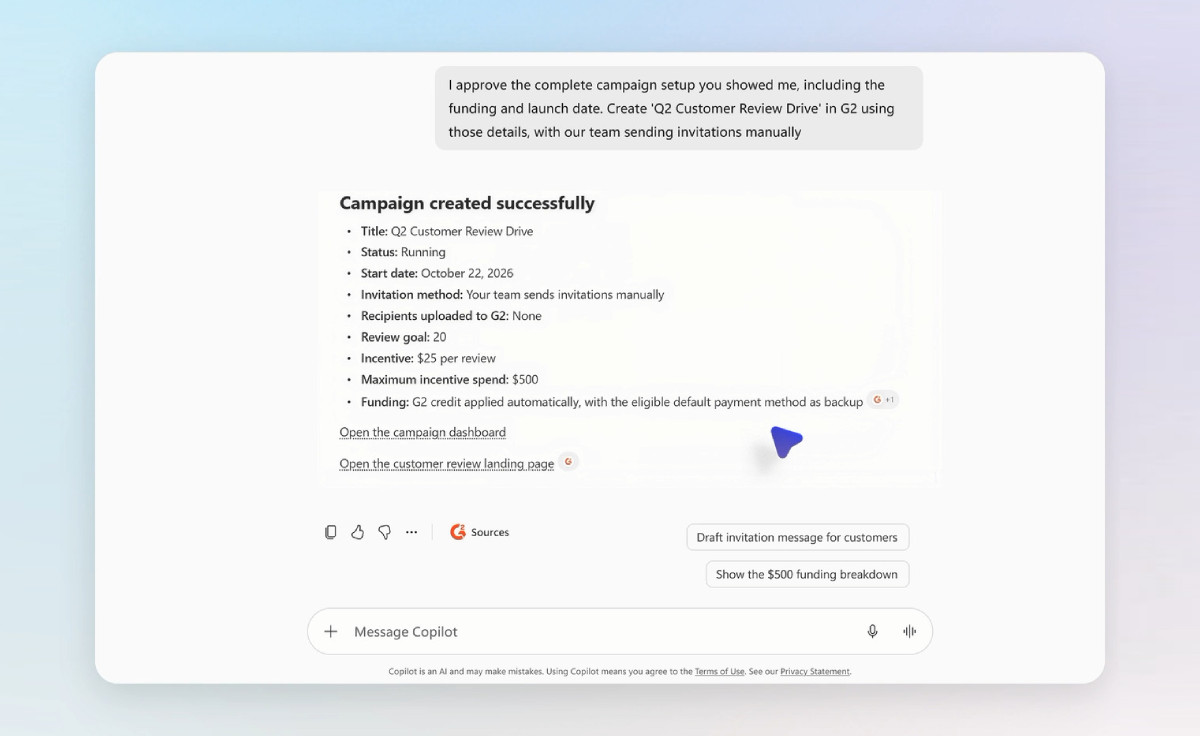
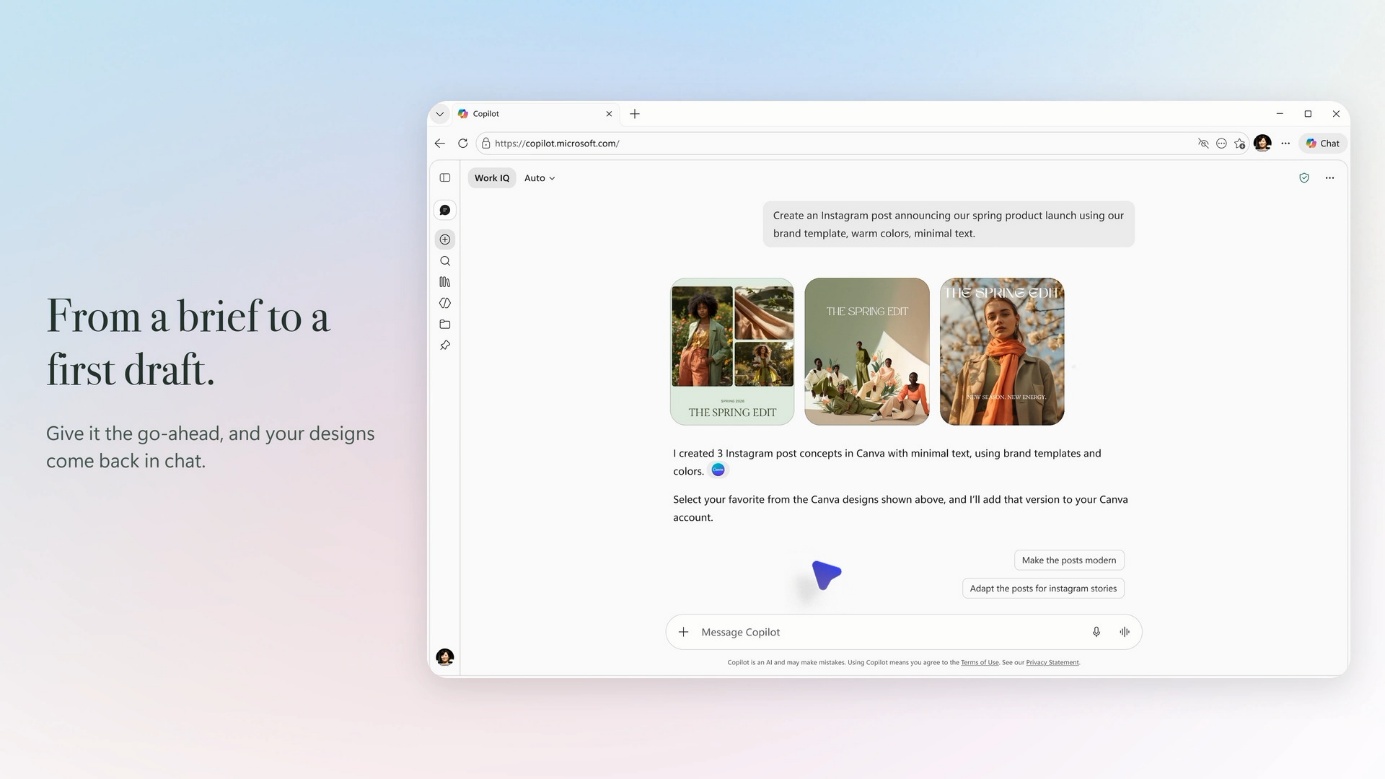
Copilot connector write actions are now generally available across Copilot Chat and Cowork. This capability lets users turn conversation context into immediate actions within connected applications. By typing plain language prompts, users can instruct Copilot to create, update, or delete information across supported platforms. Every write operation shows a confirmation card requiring approval before sending data to third-party tools. Connectors work with tools like Jira, Notion, Canva, G2, iManage, and BioRender.
Converting chat context into immediate application actions
Copilot write actions are now generally available within Copilot Chat and Cowork. This feature allows teams to take insights from ongoing chat conversations and instantly turn them into updates across connected workplace software. Users can issue plain text commands to create, modify, or erase data without switching applications. Every requested action displays a clear review card that stays pending until explicit user approval is given.
The contextual intelligence system extracts key points from conversation histories to update target databases automatically. Meeting transcripts can instantly create follow-up entries in CRM tools, while escalation emails turn into summarized issue tickets. Draft documents convert directly into presentation visual layouts, and validated spreadsheet rows import smoothly into integrated accounting systems.
Expanded third party integrations and workflow control
Integration with Atlassian Rovo enables automatic creation of Jira items and Confluence pages directly from meeting notes. Notion connectors allow instant drafting of project scope pages and status table updates derived from weekly progress emails. Visual creation through Canva turns brief text prompts into campaign graphics, while G2 handles automated campaign planning and setup. Specialized connectors like iManage streamline contract drafting from master agreements, and BioRender facilitates scientific figure assembly based on research templates.
Source: Microsoft
Safety controls stay enabled by default across all write operations to keep users in command of their data. Each execution requires manual sign-off via an on-screen prompt showing the exact payload and application involved. Users can grant temporary one-time authorization or save permanent permission settings in their chat preferences menu. System administrators manage these permissions at the organization level through the Microsoft 365 admin center, where they can review write access limits for every connected tool.
Microsoft has deployed an AI-driven agent called Licensing Navigator to speed up responses to complex product licensing questions. Built using Microsoft Foundry and Copilot Studio, the tool now handles over 1,000 queries a week from more than 800 monthly active users. A 2025 study revealed that drafting customer-ready answers is nearly 90% faster with the agent, while overall response quality rose by 140% compared to manual research. Originally created for internal sales teams, the solution now supports partners and customers across Microsoft platforms.
Microsoft Ignite 2026 kicks off this week. Key sessions for data and AI teams
Source: Microsoft
Microsoft Ignite 2026 takes place November 17-20 at the Moscone Center in San Francisco, offering a free digital pass for remote attendees. The event focuses on AI agents, Microsoft Marketplace growth, and enterprise AI governance. This article covers pass pricing, keynotes from Satya Nadella and Microsoft leaders, and top catalog sessions for teams working with Microsoft Fabric, Copilot, and enterprise data.
Event logistics and pass options in San Francisco
Microsoft Ignite 2026 runs from November 17 to 20, 2026, at the Moscone Center in San Francisco, accompanied by an online digital experience. The conference gathers industry leaders, professionals, and community members to explore developments in AI, cloud, security, data, and enterprise technology. Microsoft has confirmed the dates, venue, and pricing on its website, and the session catalog is live.
Activities begin with a pre-day on Monday, November 16, featuring badge pick-up, certifications, hands-on labs, and training focused on SecOps, Zero Trust architecture, and synthetic threat defense. Attendees can choose from three pass tiers:
- Conference pass ($2,325) - full in-person access at Moscone Center plus the digital venue.
- Hub-only pass ($1,625) - access to Hub booths, theatre sessions, and lunch from November 17 to 19.
- Digital pass (free) - access to keynotes, sessions, and technical content online.
For many international teams, such as those in the UK and South Africa, the free digital pass provides the most practical way to watch keynotes and on-demand breakout recordings.
Core themes and keynote schedule
Ignite highlights how customer demand is shifting across the partner ecosystem. The event agenda emphasizes three main shifts:
- Moving from basic copilots to autonomous AI agents managing multi-step business workflows.
- Using Microsoft Marketplace and co-selling channels to connect partner solutions with enterprise sales teams.
- Implementing strict security, governance, and responsible AI controls from the start of every project.
The opening keynote takes place on Tuesday, November 17, at 10:00 AM Pacific Time (18:00 GMT) at the Chase Center, where Satya Nadella and Judson Althoff will present new cloud and AI innovations.
On Wednesday, November 18, from 9:00 to 10:30 AM Pacific Time, Nicole Dezen, Judson Althoff, Mala Anand, Ralph Haupter, and Stephen Boyle will host the Frontier Transformation Partner keynote.
Thursday and Friday offer further technical sessions, labs, and certification opportunities.
Top data sessions and expected announcements
With over 104 sessions listed under the Data topic alone, data and AI teams have plenty of options in the catalog. Key sessions include:
- Agentic development with Fabric Copilot (BRK356) - explores Fabric Copilot as the entry point for building agents across data and apps.
- Building, deploying, and governing Microsoft Fabric at scale (BRK352) - covers workflows, observability, security, and cost management.
- AI-ready data integration with Fabric Data Factory (BRK353) - focuses on pipelines, Mirroring, dbt, and Azure Data Factory migrations.
- Building high-performance analytics with Fabric Data Warehouse (BRK350) - highlights GPU acceleration capabilities.
- Build intelligent PostgreSQL apps with HorizonDB in Microsoft Fabric (BRK359) - introduces a Fabric-native PostgreSQL experience.
- Designing Fabric IQ for enterprise adoption (BRK305), Fabric IQ: Trusted business context for enterprise AI (BRK306), and Ground agents in your business with an ontology in Fabric IQ (LAB672) - examine enterprise ontologies built on Power BI semantic models and OneLake.
- The evolution of the Microsoft Copilot app (BRK201) and Build like a startup. Deploy like an enterprise(BRK355) - showcase Chat, Cowork, Code, Autopilot, and building apps directly inside Copilot.
- Choosing the right agent architecture (BRK243), The Foundry improvement loop (BRK249), and Observability for AI with Fabric Data Agent, Foundry, and Agent 365 (LTG1214) - address Microsoft Foundry development and admin visibility.
- Govern Once, Use Everywhere: Scale Copilot with One Plugin Registry (BRK221) - Discover how organizations can safely scale Copilot extensibility through a centralized registry that unifies plugin publishing, approval, discovery, and governance.
- Plugins for Copilot: build once, govern once, use everywhere (BRK237) - Track the end-to-end lifecycle of a plugin - from initial creation and importing to deployment, governance, evaluation, and ongoing maintenance across Copilot experiences.
- Connect Once: Unlock enterprise knowledge with Copilot Connectors (BRK220) - Understand how Copilot Connectors integrate company data and internal systems into Copilot and agentic workflows, enabling users to retrieve information and execute actions seamlessly.
- What's new in Microsoft Copilot for functional roles (BRK222) - Explore how Microsoft apps and Copilot plugins embed specialized industry and business data directly into daily workflows for departments like HR, finance, and legal.
- Getting work done with Copilot as a small business (BRK223) - See how ready-to-use plugin packages bundle business-system integrations, scenarios, and prebuilt skills to simplify routine operations for small businesses.
- Skills in Microsoft Copilot (THR851) - Learn how to build, refine, and distribute reusable instruction sets - known as skills - that standardize your processes and eliminate the need to repeatedly explain recurring tasks across Copilot tools.
- Delegate complex work: Hands-on with Copilot Cowork (LAB652) - Gain practical experience constructing a Cowork workflow by converting intricate processes into reusable skills, enhancing them with automations and plugins, and delegating tasks across multiple applications.
- Copilot Connectors: Connect once. Use enterprise knowledge everywhere. (LAB654) - Walk through the process of creating, authenticating, defining actions for, and publishing a custom connector to link proprietary company systems with Copilot.
- WIQD in 15 minutes: Build, validate, and publish plugins (LTG1220) - Watch a live demonstration of Work IQ Dev Tools used to scaffold, test, and share a Copilot and Cowork plugin across an organization in just fifteen minutes.
- Skills for agents: reusable expertise that scales (LTG1181) - Find out how to properly design task-specific, reusable skills and identify the best scenarios to deploy them so AI agents produce reliable, consistent outcomes.
Based on catalog descriptions and September timelines, several unconfirmed announcements are likely. Microsoft is expected to share updates on the general availability of Copilot Code, the private preview of Autopilot, and the plugin registry.
Session descriptions for THR871 and BRK305 also suggest that Fabric IQ ontologies are nearing general availability, alongside expanded FinOps cost controls for Copilot Credits.
AI agent cuts licensing research time by nearly 90%
Source: Microsoft
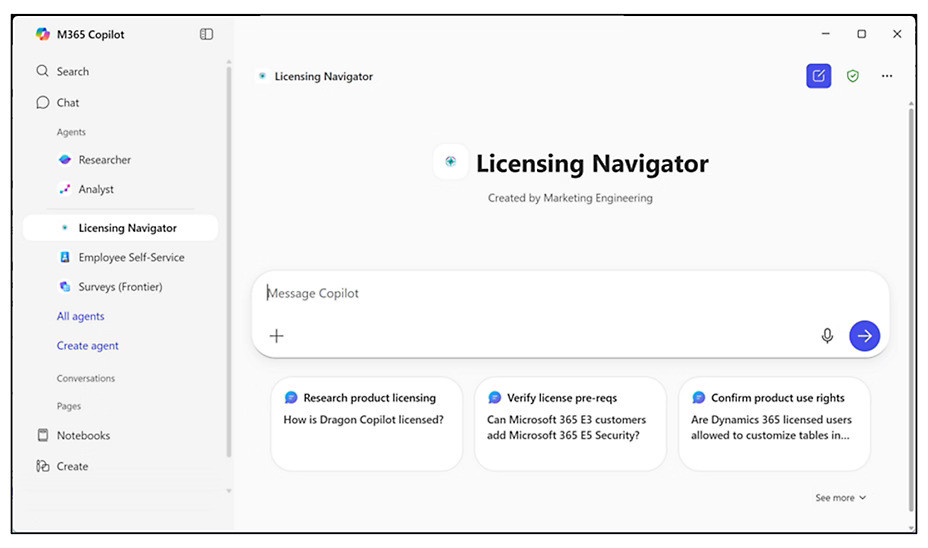
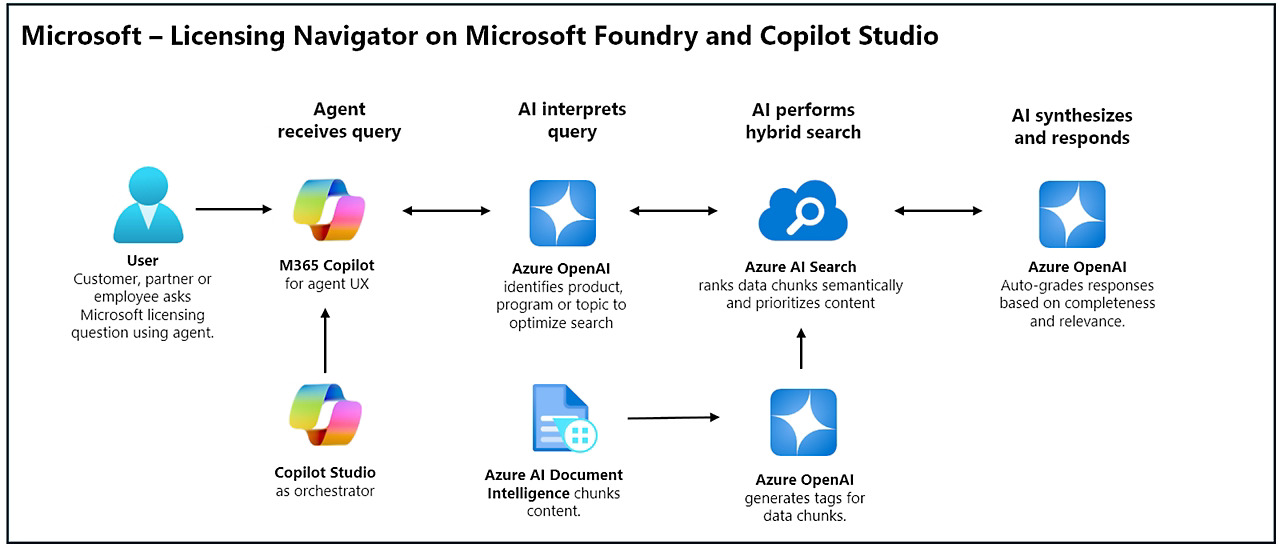
Product licensing at Microsoft has long been a complex area where employees, partners, and customers often spent an hour or more searching through dense policies without full certainty about their findings. To solve this bottleneck, the company developed Licensing Navigator, an AI-powered agent built on Microsoft Foundry and Copilot Studio.
The Licensing Navigator agent has been a complete game changer for us in the way it leverages AI to identify and synthesize relevant information. People no longer have to work through documentation and apply all that information to specific licensing scenarios. Licensing Navigator can do it all for them, instantaneously - says Mark Bratton, Director, Monetization Strategy & Licensing at Microsoft.
Initially deployed inside MSX, Microsoft's internal CRM tool, the agent targeted sales roles dealing with frequent licensing inquiries. The development team deliberately built the knowledge base using only curated, publicly available content to prepare for future customer-facing expansion.
To handle the vast amount of documentation accurately, engineers implemented a custom Retrieval-Augmented Generation (RAG) model in Microsoft Foundry, trimming nearly 600 artifacts down to the most relevant files and optimizing headers, tables, and metadata for Azure AI Search.
Integration into daily workflows drives widespread adoption
Once testing confirmed the tool's reliability, the team used Copilot Studio to bring the agent into Microsoft Teams and Microsoft 365 Copilot, sparking a sharp increase in usage. By Fiscal Year 2026, Licensing Navigator was answering over 1,000 questions weekly for more than 800 monthly active internal users.
With Microsoft Foundry and Microsoft Copilot Studio, we had all the tools we needed to finely tune our search to power our agent on a hugely complex set of licensing documentation-and provide accurate responses in a user-friendly UI - says Hunter Guffey, Senior Product Manager at Microsoft.
Ongoing engineering efforts more than doubled the agent's accuracy in fiscal year 2025 while expanding its content scope. The team shifted focus toward optimizing documents specifically for AI models, utilizing Azure OpenAI content tagging alongside Azure AI Search filtering and semantic ranking.
Source: Microsoft
This ensures that queries meant for specific programs, such as enterprise licensing, return answers exclusively from matching tagged content, while added features like deep source links and multi-turn conversation support help users validate responses effortlessly.
Proven accuracy leads to partner and customer rollout
A 2025 study confirmed that using Licensing Navigator made drafting customer-ready responses with supporting references almost 90% faster than working without it. Furthermore, the combined accuracy and completeness of the generated answers proved 70% higher than other AI tools and 140% higher than traditional manual research.
Backed by strong performance and positive internal feedback, Microsoft integrated the agent into the Partner AI assistant in Partner Center, followed months later by a rollout to the Ask Microsoft AI assistant on Microsoft.com. Partner testers praised the rapid response times and high answer quality on tricky licensing topics. Today, Licensing Navigator serves as a blueprint for streamlining complex business processes, reducing the workload on specialists, and enabling self-service support at scale.
US plans Chinese tech ban. Microsoft warns of AI delays

Source: Microsoft
Microsoft and major tech companies are pressing the Trump administration to drop plans for a ban on Chinese optical transceivers. These components are vital for high-speed data transmission within AI facilities. Industry leaders warn that prohibiting imports over security concerns could stall data center construction across the country. With US suppliers unable to meet market demand, cutting off Chinese vendors threatens to derail American progress in the global artificial intelligence race.
Microsoft lobbies over data center import restrictions
Microsoft and major tech entities are lobbying the Trump administration to halt a planned ban on Chinese-made optical transceivers. These components, critical for transmitting data at light speed within data centers, face potential import bans over White House fears of espionage, malware installation, or service disruption by Beijing. However, industry representatives warn that cutting off Chinese suppliers could severely hamper American data center expansion and stall the deployment of artificial intelligence infrastructure.
The cloud provider, currently constructing 35 data centers and planning 134 more across the United States, joined industry groups in September meetings with the White House Office of Science and Technology Policy and the National Security Council. Sector representatives warned officials that a sudden embargo would trigger severe supply chain bottlenecks. The Federal Communications Commission is leading the effort to enact the ban, sparking widespread concern across the tech sector as companies scramble to expand infrastructure to meet skyrocketing AI demand.
It really threatens to arguably grind (the data center rollout) to a halt - said John Miller, general counsel of the Information Technology Industry Council. He pointed out that US hyperscalers have already secured expensive AI processing chips that cannot function without fiber-optic links.
Those chips, without optical transceivers literally could just sit there waiting around un-utilized until you actually have the transceivers to essentially connect them together - he added.
Supply chain risks threaten US technology initiative
Chinese manufacturers currently control roughly two-thirds of the worldwide market for optical transceivers. Dominant Chinese suppliers like Eoptolink and Zhongji Innolight, the latter of which features on the US Pentagon list of military-backed entities, provide essential hardware to major American tech firms. Domestic alternatives from US companies such as Coherent and Lumentum exist, but market analysts note these domestic suppliers currently lack the manufacturing capacity to replace Chinese production volume.
To mitigate supply shocks while addressing national security concerns, federal regulators are weighing targeted speed limits rather than a total trade prohibition. Officials are considering restricting imports specifically for next-generation transceivers rated at 3.2 terabits per second, a technology standard expected to enter mass production in 2028 and achieve widespread deployment by 2029. This targeted approach aims to grant domestic suppliers critical time to scale up production capacity without immediately freezing existing data center construction projects.
Political pressure continues to escalate on multiple fronts. The Information Technology Industry Council formally petitioned the telecoms regulator to refrain from blacklisting optical components, emphasizing the severe potential impact on national technology leadership. Meanwhile, bipartisan lawmakers introduced legislative measures targeting federal networks, seeking to prohibit the installation of Chinese-made transceivers in sensitive government computer systems.
One-employee biotech joins Anthropic. AI reshapes drug discovery

Source: Anthropic
Anthropic’s acquisition of Mithril Medicine, a one-person biotechnology startup powered by the AI assistant Claude, has ignited debate over the future of pharmaceutical research. While the Cambridge firm developed two early-stage muscular dystrophy antibodies with a single full-time employee, its actual workflow depended heavily on external consultants and five contract research organizations. Industry experts note that although AI agents streamline early discovery, tiny startups still face major data limitations, regulatory hurdles, and a continued need for human-run laboratories.
Anthropic acquires one-person AI biotech startup
San Francisco artificial intelligence giant Anthropic recently expanded into biomedical science by acquiring Mithril Medicine, a Cambridge-based biotechnology firm with just one full-time employee. The startup developed two early-stage antibody candidates targeting a rare form of muscular dystrophy while relying heavily on Anthropic’s AI assistant, Claude, to analyze data, propose research steps, and manage administrative paperwork. Although the acquisition sparked widespread industry debate over whether solo-founder startups represent the future of pharmaceutical development, the reality behind Mithril's operations reveals a much broader human network.
To generate its promising therapeutic leads, Mithril Medicine brought in part-time scientific consultants and outsourced laboratory experiments to at least five contract research organizations.
It takes a village to develop a drug - says Jeb Keiper, a partner at Boston venture-capital firm Third Rock Ventures, noting that advancing these antibodies into clinical trials will require substantially larger teams. Former Mithril chief executive Cody Tranbarger, who joined Anthropic following the absorption of his company, previously described this lean setup on LinkedIn as a new operating model termed "Pipeline-in-a-Person."
Operating ultra-lean biotechs without physical laboratories is not entirely unprecedented, though modern AI tools are accelerating the trend. Entrepreneur Matt Davidson founded his first biotech firm in 2013 with only two full-time employees, outsourcing all experimental work until late-stage clinical testing. Today, his Los Angeles company, Azora Therapeutics, operates with five staff members and uses AI primarily to summarize reports, reducing its historical dependence on external consultants.
Operational limits of ultra-lean drug discovery
Other innovators are pushing the automation boundary even further toward fully autonomous operations. In Seattle, co-founder Hannah Shen is building Kekulai, a startup aiming to deploy AI systems capable of managing drug development from start to finish with minimal human intervention. Currently, however, Kekulai still relies on five full-time employees, a group of part-time consultants, and nearly 300 AI agents to guide its research, demonstrating that complete automation remains a distant goal.
Despite the agility of AI-assisted micro-firms, operating at such a small scale introduces significant data and regulatory hurdles. Stanford University computer scientist James Zou, who co-developed an agent-based system called the Virtual Biotech to design lung cancer strategies, chose to partner with a major pharmaceutical company rather than launch a tiny startup. If you’re a one-person biotech, you’re relatively limited in terms of how much data the agents can learn from - explains Zou
Advancing experimental therapies beyond initial discovery also confronts strict government oversight and physical laboratory constraints. While AI agents can help solo founders reach the regulatory filing stage, interacting with government agencies during heavily regulated clinical trials demands extensive human expertise.
Furthermore, computational drug discovery researcher Vasanthanathan Poongavanam at Uppsala University notes that autonomous laboratories are still developing, meaning tiny biotechs will continue depending on human scientists at contract research organizations to execute physical experiments for the foreseeable future.
Gemini 4 Hydrogen is here. Multi-model workflows just evolved
Source: Google
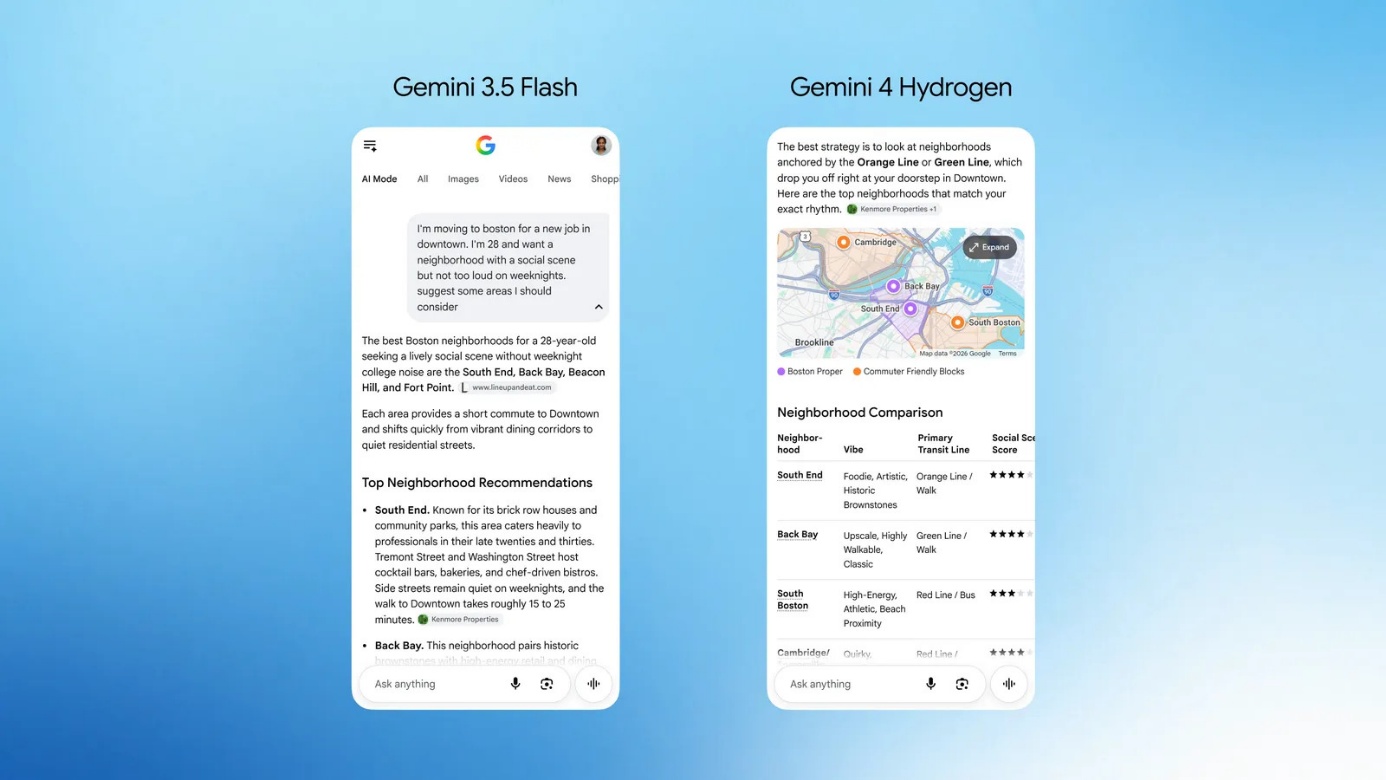
Google has introduced Gemini 4 Hydrogen, a faster and more affordable AI model built for high-volume coding, rapid execution, and agentic workflows. Despite sitting below flagship models Carbon and Argon, Hydrogen surpasses Argon on the Artificial Analysis Intelligence Index and triples Gemini 3.8 Flash scores on Terminal-Bench 4.1. Priced at $1.50 per million input tokens, it features four thinking levels and a 1 million-token context window. Alongside the release, Google launched Orchestrator in Antigravity and rolled out Hydrogen across Search and the Gemini app.
Gemini 4 Hydrogen outpaces Argon in benchmark testing
Google has officially expanded its Gemini 4 family with the launch of Gemini 4 Hydrogen, a model engineered for rapid execution and high-volume coding rather than long-horizon reasoning. Positioned beneath the frontier Gemini 4 Carbon and Argon models, Hydrogen manages to outperform Argon on the Artificial Analysis Intelligence Index, scoring 51 at its default high thinking level compared to Argon's 50, and reaching 54 at its new xhigh setting.
Hydrogen is built to stand on its own as a model for everyday work - or to pair with Carbon and Argon as the high-efficiency execution engine in multi-model workflows - Google explained in its announcement.
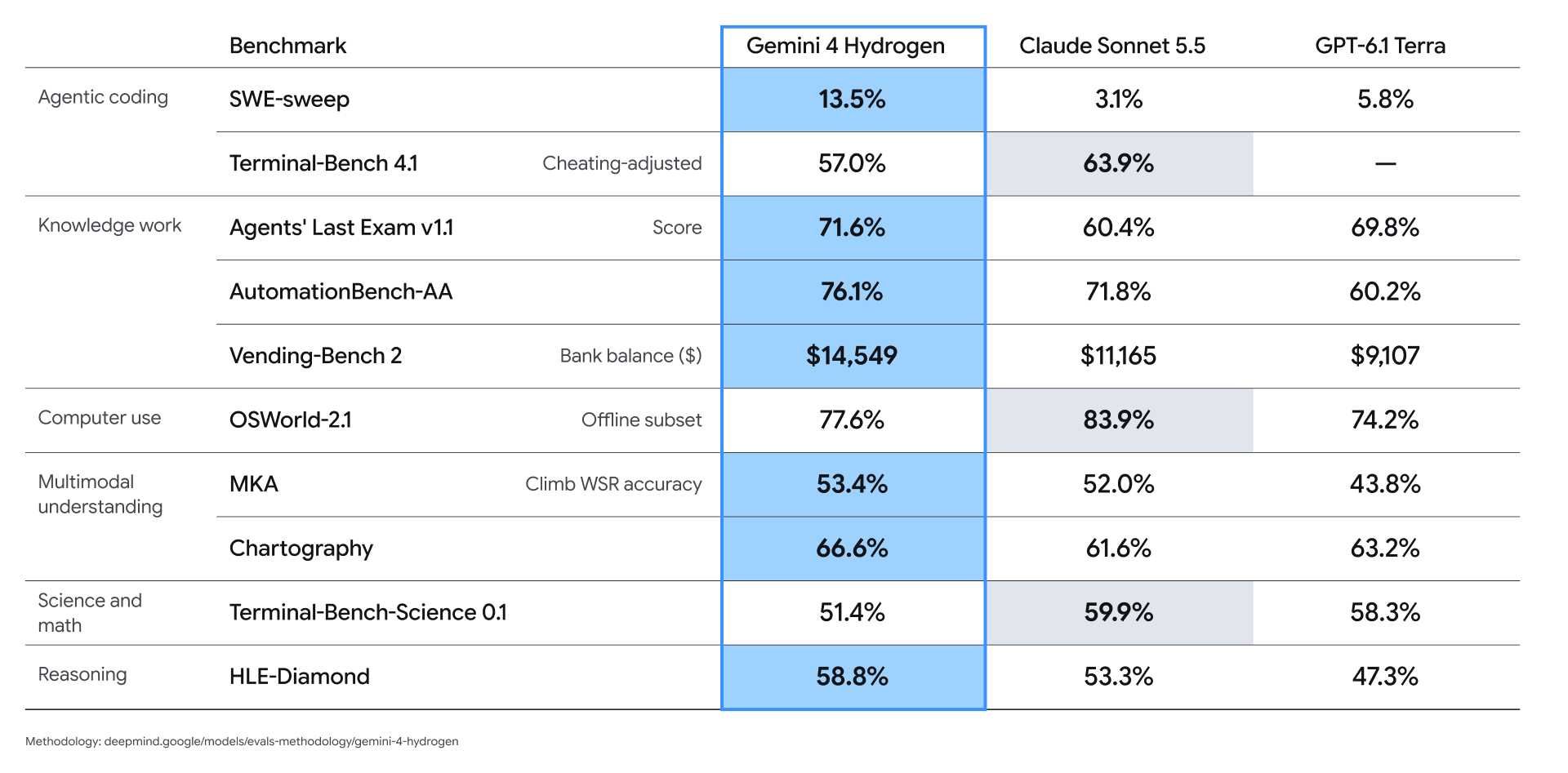
The new release represents a massive leap forward for teams migrating from Gemini 3.8 Flash. Hydrogen finishes tasks 2.5 times faster at its default setting while tripling Terminal-Bench 4.1 scores from 18.2% to 57%, cutting fabricated claims by over five times. It also holds its own against external competitors like Claude Sonnet 5.5 and GPT-6.1 Terra across several evaluations, leading its class on HLE-Diamond at 58.8% and ranking first overall on the Vals Tax Agent Bench. While Sonnet 5.5 still leads in computer-use tasks and Terminal-Bench 4.1, Hydrogen excels in iterative repository debugging by batching file-read and search calls in parallel.
To give developers granular control over latency and token consumption, Hydrogen supports four distinct thinking levels ranging from low to xhigh. It retains a native 1 million-token context window capable of processing text, images, audio, and video, paired with up to 1 million output tokens for synthesizing dense documents into structured reports.
Google priced the model flat across its entire context window at $1.50 per million input tokens and $7.50 per million output tokens. While that makes it twice as expensive as Gemini 3.8 Flash and 50% pricier than GPT-6.1 Terra, it remains 25% cheaper than current promotional rates for Carbon and Argon, and 62.5% cheaper than their regular pricing starting December 1.
Antigravity Orchestrator streamlines multi-model coding workflows
Alongside the model debut, Google rolled out a new Orchestrator feature within Google Antigravity to automate multi-model collaboration. Instead of forcing developers to rely on a single model from start to finish, Orchestrator dynamically switches between Carbon and Hydrogen within the same session.
In complex parallel workflows, Carbon acts as the coordinator handling deep architectural judgment, while Hydrogen powers worker and verifier agents across isolated workspaces. According to Google, this dynamic pairing achieved near-Carbon task success rates on Terminal-Bench 4.0 while cutting quota consumption by 24% and speeding up completion times by 19%.
Source: Google
Security and alignment also received major upgrades in the Gemini 4 stack to support autonomous agentic execution at scale. Google noted that Hydrogen reduces overreach in agentic tasks by up to 81% and cuts misaligned actions across coding evaluations by 12 times compared to 3.8 Flash.
The model achieved a 96.7% honesty rate on internal evaluations, preserved 99.9% chain-of-thought legibility across 200,000 audited turns, and proved more than 2.3 times as resilient against indirect prompt injection attacks on the Gray Swan IPI benchmark.
Global rollout brings faster assistance to Search and Gemini apps
Beyond developer environments, Gemini 4 Hydrogen is now rolling out globally across Google's consumer and enterprise products. Everyday users can access the model immediately through Google Search and the Gemini app model dropdown, with free Gemini users receiving access via automatic model selection.
Google stated that Hydrogen makes the everyday assistant noticeably more reliable, noting that it's better at following your guidance, calling the right tools, and getting you to a reliable output with less back-and-forth when pulling context from Gmail, Google Drive, or Connected Apps like Airtable and Dropbox.
In Google Search, Hydrogen powers an upgraded query fan-out technique designed to handle multi-part questions, heavy typos, and highly specific requests. Users will see more adaptive, visual responses alongside a broader range of relevant web links. Meanwhile, developers and businesses can begin building with Hydrogen immediately via Google AI Studio, Android Studio, the Gemini API, Gemini for business, and Gemini in Google Sheets for eligible workspace and paid AI Pro or Ultra subscribers.
Converting chat context into immediate application actions
Copilot write actions are now generally available within Copilot Chat and Cowork. This feature allows teams to take insights from ongoing chat conversations and instantly turn them into updates across connected workplace software. Users can issue plain text commands to create, modify, or erase data without switching applications. Every requested action displays a clear review card that stays pending until explicit user approval is given.
The contextual intelligence system extracts key points from conversation histories to update target databases automatically. Meeting transcripts can instantly create follow-up entries in CRM tools, while escalation emails turn into summarized issue tickets. Draft documents convert directly into presentation visual layouts, and validated spreadsheet rows import smoothly into integrated accounting systems.
Expanded third party integrations and workflow control
Integration with Atlassian Rovo enables automatic creation of Jira items and Confluence pages directly from meeting notes. Notion connectors allow instant drafting of project scope pages and status table updates derived from weekly progress emails. Visual creation through Canva turns brief text prompts into campaign graphics, while G2 handles automated campaign planning and setup. Specialized connectors like iManage streamline contract drafting from master agreements, and BioRender facilitates scientific figure assembly based on research templates.