

Microsoft Fabric unifies PostgreSQL workloads and enterprise AI context
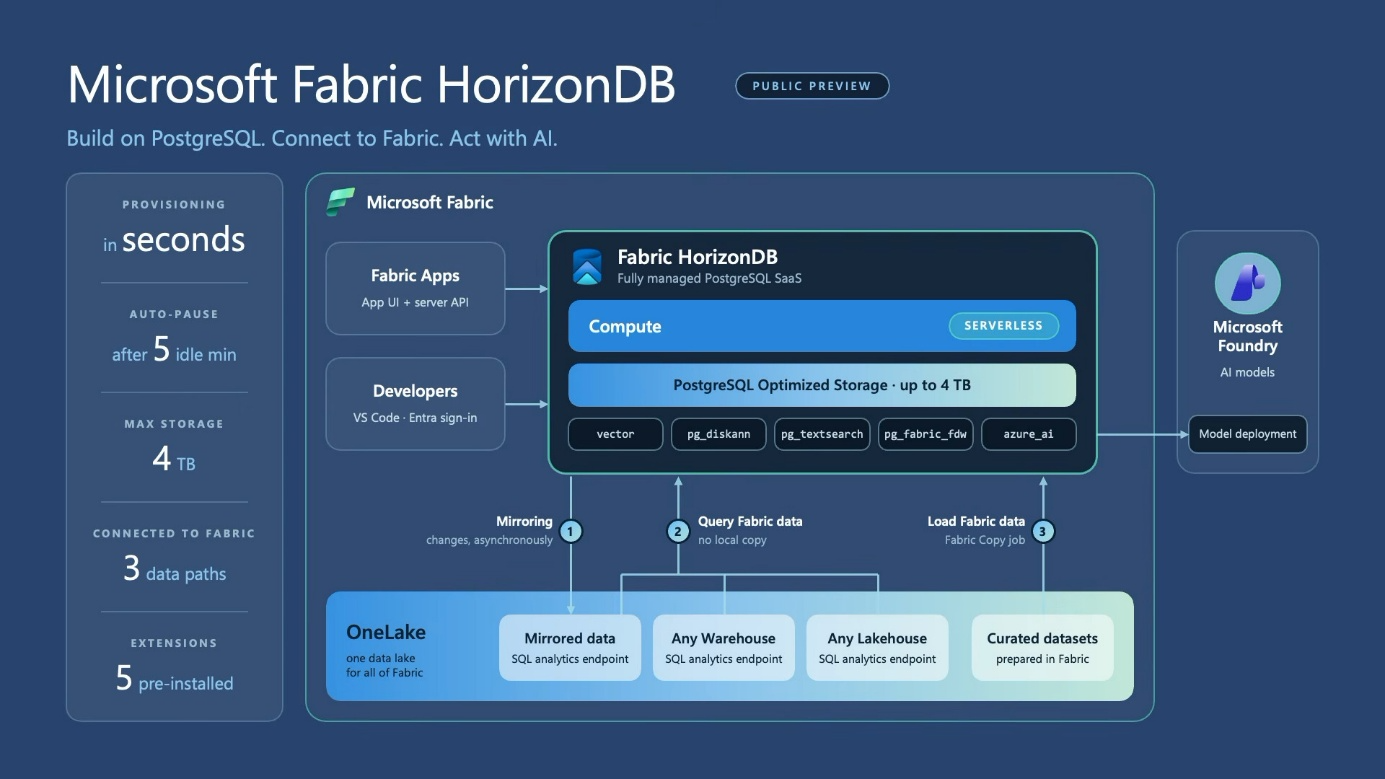
Microsoft has introduced Fabric HorizonDB in public preview alongside general availability for Database Hub, Fabric apps, and the new Microsoft IQ platform. These architectural updates consolidate operational PostgreSQL databases, governed application backends, and reusable AI business context directly within Microsoft Fabric and Microsoft Foundry, reducing data duplication and governance overhead for enterprise data teams.
Operational PostgreSQL converges with analytics in Fabric
Microsoft Fabric now enables developers to run serverless, Fabric-native PostgreSQL workloads through Fabric HorizonDB, currently in public preview. Positioned alongside SQL database and Cosmos DB in Fabric, this addition allows operational transactions, analytics, and AI models to share a single governed data estate without building complex ETL pipelines. To simplify oversight across hybrid estates, Database Hub in Fabric has also reached general availability, giving data platform managers a unified interface to monitor and govern databases across Azure, on-premises environments, and Fabric.
For enterprise data architects, bringing PostgreSQL natively into Fabric eliminates a major architectural boundary between transactional applications and analytical estates. Organisations standardising on open-source relational databases no longer need to replicate data into separate analytical stores before grounding AI workloads. Coupled with the general availability of Fabric apps, teams can now move from natural-language prototypes in Microsoft Copilot to production applications backed by Fabric's authentication and governance controls, while Power BI creators can turn existing semantic models into interactive operational apps in preview.
Shared enterprise context links Fabric and Foundry
Microsoft has introduced Microsoft IQ to stop teams from rebuilding domain knowledge for every new AI agent. Bringing together Fabric IQ, Foundry IQ, Work IQ, Web IQ, and over 350 connectors, the platform establishes a single governed layer where semantic models in Power BI, documents, and core operational records are captured once and reused across Microsoft Foundry, Microsoft Copilot, and third-party assistants via APIs and the Model Context Protocol.
For heads of data and analytics, this integration directly addresses the governance risks of fragmented AI deployments. Instead of exposing raw data sources to isolated agents, domain experts can package business logic into reusable plugins - such as combining order semantic models in Fabric IQ with supplier contracts in Foundry IQ - while preserving existing enterprise permissions and evaluation standards across the entire lifecycle.
By unifying operational PostgreSQL storage, governed app backends, and cross-platform AI context, Microsoft is positioning Fabric and Foundry as a single architectural spine for enterprise data estates. Mid-market and large organisations can reduce integration costs, enforce consistent security policies, and turn existing Power BI semantic models into governed operational assets without managing fragmented infrastructure.
Learn more on Microsoft Azure Blog
On-premises data gateway gains regional failover and security hardening
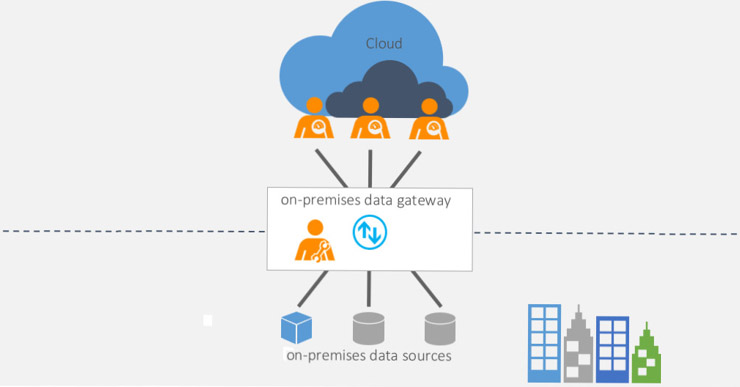
Microsoft has introduced Dual Relay resiliency in the November 2026 release of the on-premises data gateway (version 3000.342), automatically routing traffic to a backup region if a primary relay fails. Alongside this architectural safeguard, the update patches critical cryptography dependencies, stabilizes service principal authentication, and aligns query execution logic with the latest Power BI Desktop release for enterprise data teams.
Automatic failover removes single-region bottlenecks
For mid-market and enterprise organisations relying on hybrid data architectures, a regional Azure relay outage has historically meant broken scheduled refreshes and stalled analytics pipelines. The new Gateway Dual Relay capability addresses this architectural vulnerability by provisioning both a primary relay endpoint and a secondary relay in a backup region.
If the primary relay becomes unreachable, the gateway fails over automatically to the secondary endpoint without manual intervention, provided network connectivity allows it. For Data Platform Managers and IT teams operating under strict service level agreements, this removes a critical single point of failure in hybrid Microsoft Fabric deployments while requiring zero manual activation on eligible gateways.
Hardened authentication and lower memory overhead
Beyond high availability, version 3000.342 targets operational stability under heavy enterprise workloads. The update fixes an authentication flaw where service principal token refresh metadata was occasionally dropped across operations, preventing intermittent failures in automated data pipelines.
Engineers also refined request throttling, improved caching efficiency, and reduced memory allocation overhead during serialization, resulting in more predictable resource consumption on gateway host servers.
On the security front, the release patches a known vulnerability in the System.Security.Cryptography.Pkcs dependency alongside broader third-party component updates. It also expands diagnostics within the gateway setup application and improves Oracle DirectQuery performance, giving infrastructure teams clearer visibility when troubleshooting complex enterprise connectors.
Maintaining consistent query execution across environments
Upgrading to version 3000.342 ensures that the cloud service executes queries using the exact same runtime logic as the November 2026 edition of Power BI Desktop, eliminating discrepancies between local development and production refreshes.
For Heads of Data and BI Managers overseeing mission-critical reporting, prioritising this upgrade reduces unplanned downtime, strengthens compliance posture, and keeps hybrid data movement reliable at scale.
Learn more on Fabric Updates Blog
Microsoft Foundry cuts AI agent operational costs with GPT-6.2 Astra and GPT-6.2 Sol

Microsoft has introduced GPT-6.2 Astra and GPT-6.2 Sol in Microsoft Foundry, giving data and IT leaders general availability access to reasoning and production-grade models built for autonomous enterprise workflows. By pairing higher reasoning accuracy with reduced output token consumption and extended 12-hour prompt caching, this release directly lowers cost per task while keeping data processing within strict regional compliance boundaries.
Smarter reasoning and extended caching lower cost per task
For data platform managers and architects scaling AI beyond basic chat interfaces, token consumption quickly becomes a primary budget concern. GPT-6.2 Astra improves on its predecessor across complex reasoning, coding, and document or spreadsheet generation while generating substantially fewer output tokens. Meanwhile, GPT-6.2 Sol targets high-frequency production agents, focusing on concise technical writing, debugging, and precise tool selection.
To further control spend, both models introduce an opt-in 12-hour prompt cache write option alongside the standard 30-minute default. For enterprise agents that sit idle overnight or between batch cycles, platform teams can retain large system instructions, schemas, and tool definitions in cache without paying repeated write fees the following morning.
Flexible deployment options simplify governance and data residency
Moving AI workloads from prototype to production in regulated UK and European enterprises frequently stalls over data residency and security reviews. Microsoft addresses this by offering both models across three deployment configurations at launch: Global Standard, Global Provisioned Throughput, and Data Zone Standard. Data Zone Standard ensures processing remains strictly within the EU, US, or APAC, allowing architecture teams to meet compliance mandates without sacrificing access to frontier models.
Because deployment types can be switched without altering underlying application code, engineering teams gain architectural agility as workloads scale. Both models inherit Azure's baseline enterprise controls, including Microsoft Entra identity management, private network endpoints, prompt injection mitigations, and Microsoft Purview governance policies, ensuring prompts and outputs are never used for model training.
For Chief Data Officers and Heads of Analytics, this release shifts enterprise AI from experimental proofs-of-concept to predictable, governable production infrastructure. Data engineering and analytics teams building automated reporting pipelines or multi-step operational agents benefit most, gaining finer control over latency, regional compliance, and unit economics without re-architecting existing Foundry integrations.
Learn more on Microsoft Foundry Blog
Microsoft Foundry introduces automated continuous improvement to cut AI costs and boost agent reliability
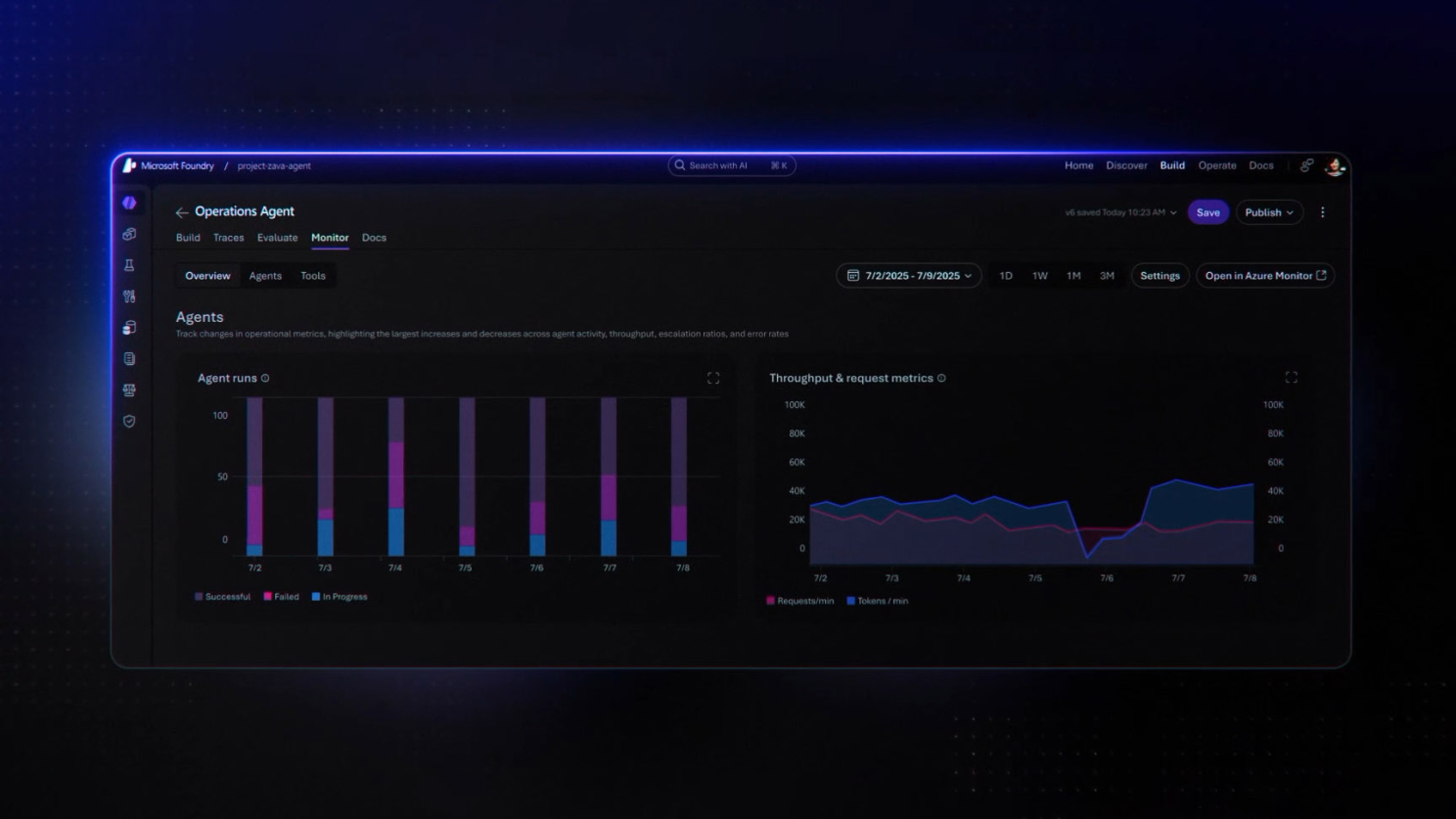
Microsoft has introduced an end-to-end continuous improvement framework within Microsoft Foundry, enabling enterprise organisations to systematically evaluate, optimise, and govern AI agents in production. By turning real-world usage logs and expert feedback into automated benchmarks, teams can safely refine agent performance while cutting token expenses by up to 65%. For data and IT leaders scaling AI beyond initial pilots, this closes the critical gap between deploying an agent and maintaining its accuracy over time.
Turning production traces into governed agent upgrades
Out-of-the-box foundation models deliver identical capabilities to every organisation, meaning enterprise differentiation depends on how effectively agents adapt to internal context. Foundry addresses this by establishing a four-step operational loop - Establish, Identify, Optimize, and Validate - anchored by Microsoft IQ. Rather than relying on static, hypothetical test cases, teams can now annotate real production traces (in preview) to build "golden datasets" that act as strict quality benchmarks.
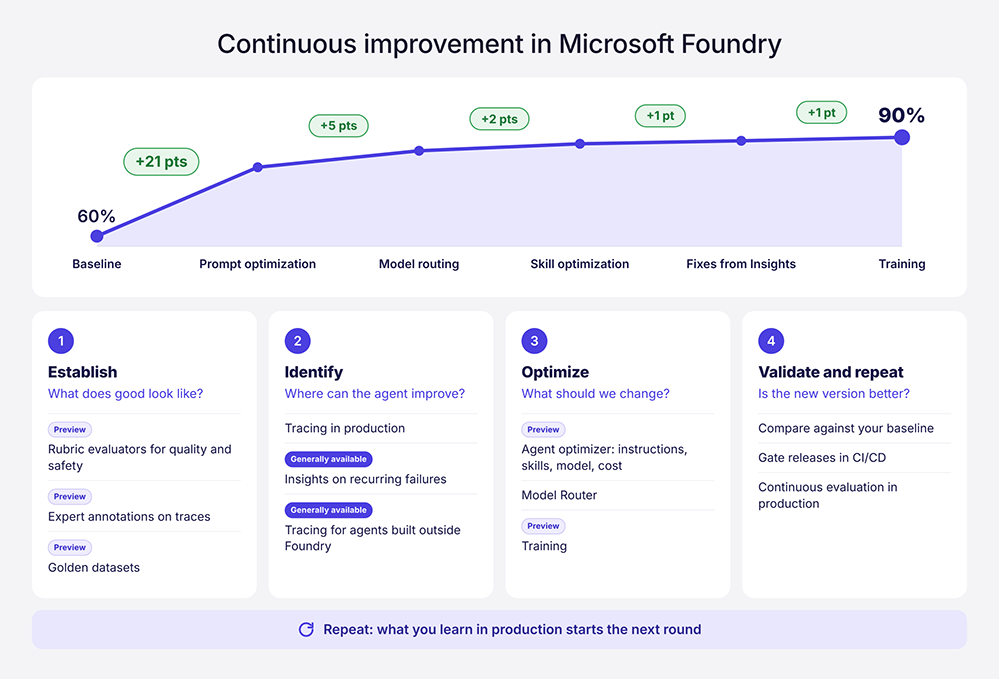
When recurring issues emerge in live traffic, Insights (now in GA) automatically groups failures and pinpoints root causes across both Foundry-native agents and external frameworks like LangGraph, LangChain, and CrewAI. Data architects and engineering leads can feed these insights directly into the Agent optimizer (in preview), which generates and tests improvements to prompts, versioned skills, or underlying model selections. Crucially, statistical testing and CI/CD integration via GitHub Actions or Azure DevOps ensure no update reaches production without clearing predefined quality and safety bars.
Balancing enterprise governance with aggressive cost optimisation
Operating hundreds of autonomous agents across global regions requires strict identity management and predictable compute economics. Foundry enforces zero-trust principles at runtime using Entra Agent ID and Foundry Safety guardrails, ensuring agents only access authorised data while keeping humans in the loop for sensitive actions. Simultaneously, hosted agents in Foundry Agent Service (now in GA for higher concurrency) allow enterprises to run their preferred orchestration layers without sacrificing central oversight.
To prevent runaway inference costs, Foundry provides granular levers for model efficiency. Its intelligent model router dynamically directs simple queries to smaller, faster models and reserves frontier models for complex reasoning, delivering up to 65% savings in testing. For specialised workloads, organisations can use Managed Training or Python-based Programmed Training (in preview) on serverless GPUs to fine-tune open-weight or Microsoft AI (MAI) models. Early enterprise adopters demonstrate significant financial returns: Docusign reduced AI processing costs by 90% using fine-tuned models, while Alaska Airlines raised maintenance classification accuracy from 81.2% to 91.1% at a fraction of frontier model pricing.
For mid-market and enterprise leaders, these updates shift agentic AI from an experimental cost centre to a governed, self-improving asset. By linking continuous evaluation directly to automated cost and skill optimisation, organisations can scale AI deployments across thousands of internal workflows while retaining full control over data security, operational risk, and long-term return on investment.
Learn more on Microsoft Azure Blog
Microsoft Fabric unites app development, serverless PostgreSQL and database operations
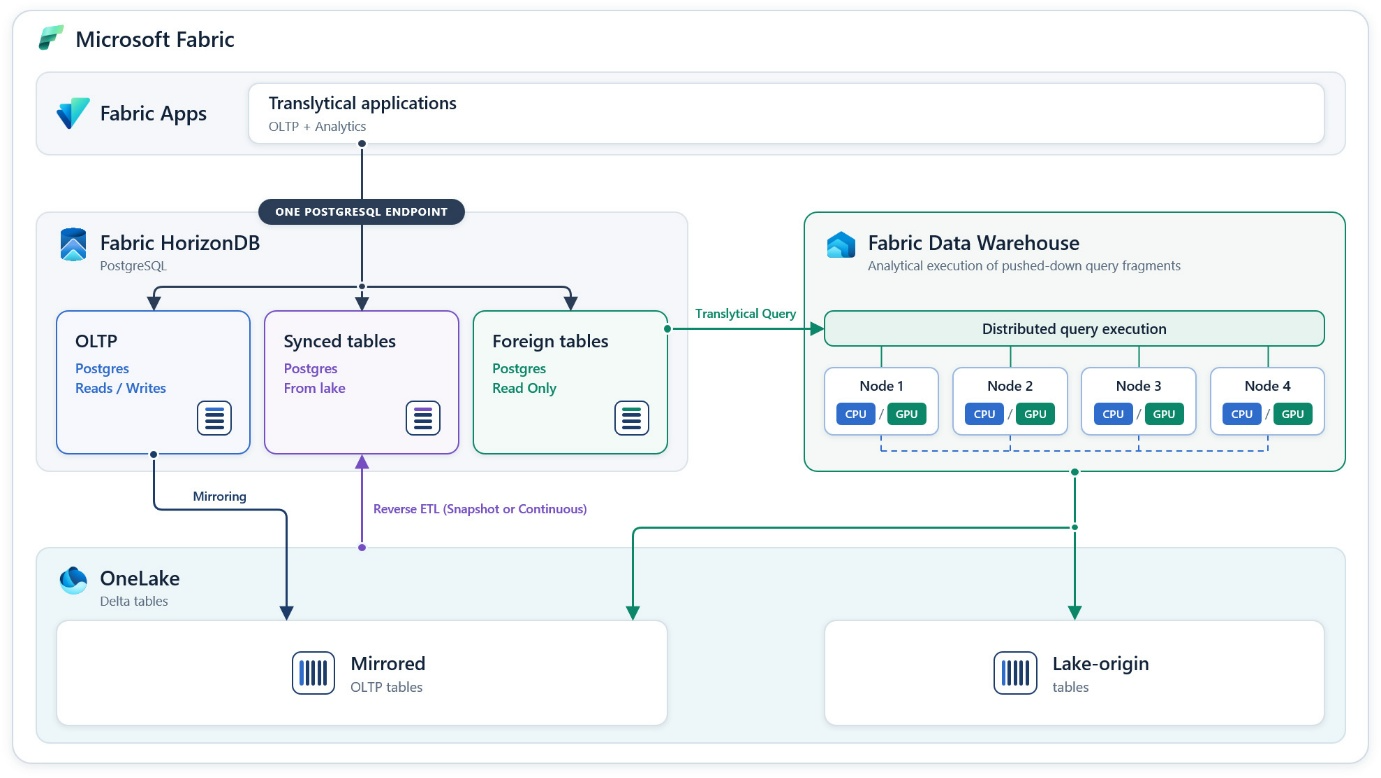
Microsoft has introduced three major updates in Microsoft Fabric to simplify how enterprise teams build, deploy and manage intelligent applications. Fabric apps and Database Hub are now generally available, while serverless PostgreSQL arrives in preview through Microsoft Fabric HorizonDB. Together, these releases bridge the gap between AI-assisted prototyping and production-grade enterprise architecture by embedding governance, translytical processing and automated database operations directly into the core data platform.
Governing AI-built apps on trusted enterprise data
Moving AI-generated prototypes into production often stalls when developers have to manually rebuild security models, data pipelines and governance controls. With Fabric apps now generally available, developers and coding agents can use the open-source Rayfin SDK and CLI to build complete applications backed by existing OneLake semantic models, warehouses and lakehouses. Having already seen over 100,000 apps created during its five-month preview, the platform now provides a direct route from Power BI Desktop or Microsoft Copilot prompts to governed enterprise workflows without duplicating data or access rules.
For data leaders and platform architects, the general availability release introduces essential administrative guardrails. A new Apps view inside the OneLake Governance hub gives IT and data governance teams central visibility across the organisation, allowing administrators to block or unblock applications as needed. Combined with Content Security Policy controls and private site hosting, organisations can allow business units and coding agents to build interactive operational apps while maintaining strict compliance over underlying data assets.
Eliminating ETL pipelines with serverless PostgreSQL
To support the bursty, unpredictable workloads typical of modern applications and autonomous agents, Microsoft has launched Fabric HorizonDB in preview. HorizonDB offers a serverless PostgreSQL engine that provisions in seconds, pauses compute automatically after five minutes of inactivity to control cloud spend, and resumes on demand when queries arrive. This architecture removes the infrastructure overhead and idle capacity costs traditionally associated with spinning up operational databases for short-lived agentic tasks or new internal tools.
More importantly for enterprise architecture, HorizonDB connects operational transactions directly to analytical engines via OneLake without requiring custom integration pipelines. Tables are mirrored to OneLake in Delta format by default, while translytical query pushdown allows a single PostgreSQL query to join live transactional data with Fabric Data Warehouse tables at scale. Enriched analytical outputs can also flow back into HorizonDB via continuous or snapshot synced tables, giving applications low-latency access to updated scores and aggregates through one unified endpoint.
Shifting database teams from reactive fixes to proactive control
As developers and AI agents rapidly provision new databases, data platform managers face growing estate sprawl and operational complexity. The general availability of Database Hub in Fabric addresses this by centralising database discovery, health monitoring and performance diagnostics into a single management plane.
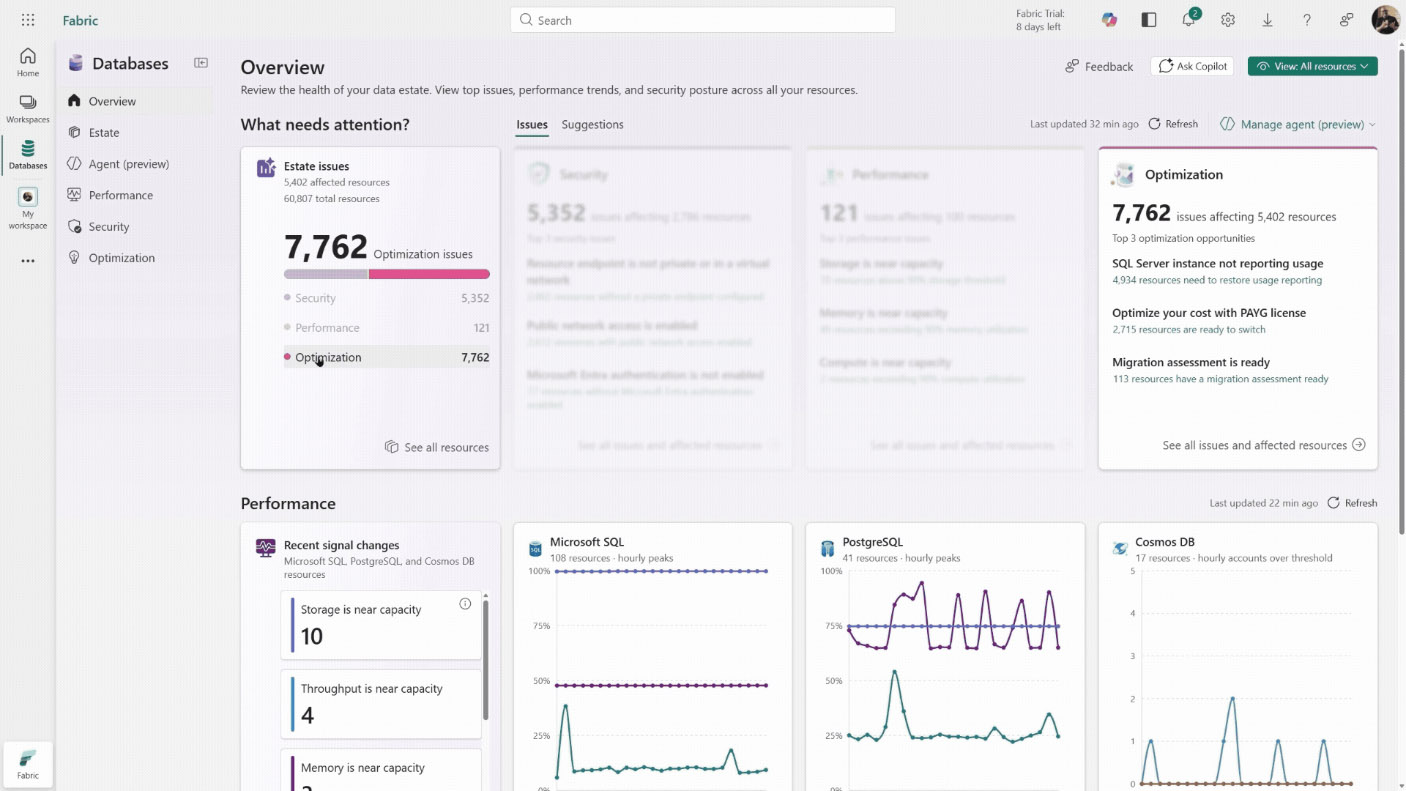
Instead of jumping between disparate tools, database administrators and platform engineers gain unified visibility across their Fabric database estate, supported by natural language troubleshooting through Copilot and new preview database agents for SQL and PostgreSQL that identify root causes and recommend optimisations.
For mid-market and enterprise organisations running Fabric, these capabilities reduce the architectural friction between operational software and enterprise analytics. Data leaders can consolidate transactional databases, analytical engines and application governance under one roof, lowering total cost of ownership while accelerating the safe deployment of internal business applications.
Learn more on Fabric Updates Blog